Introduction
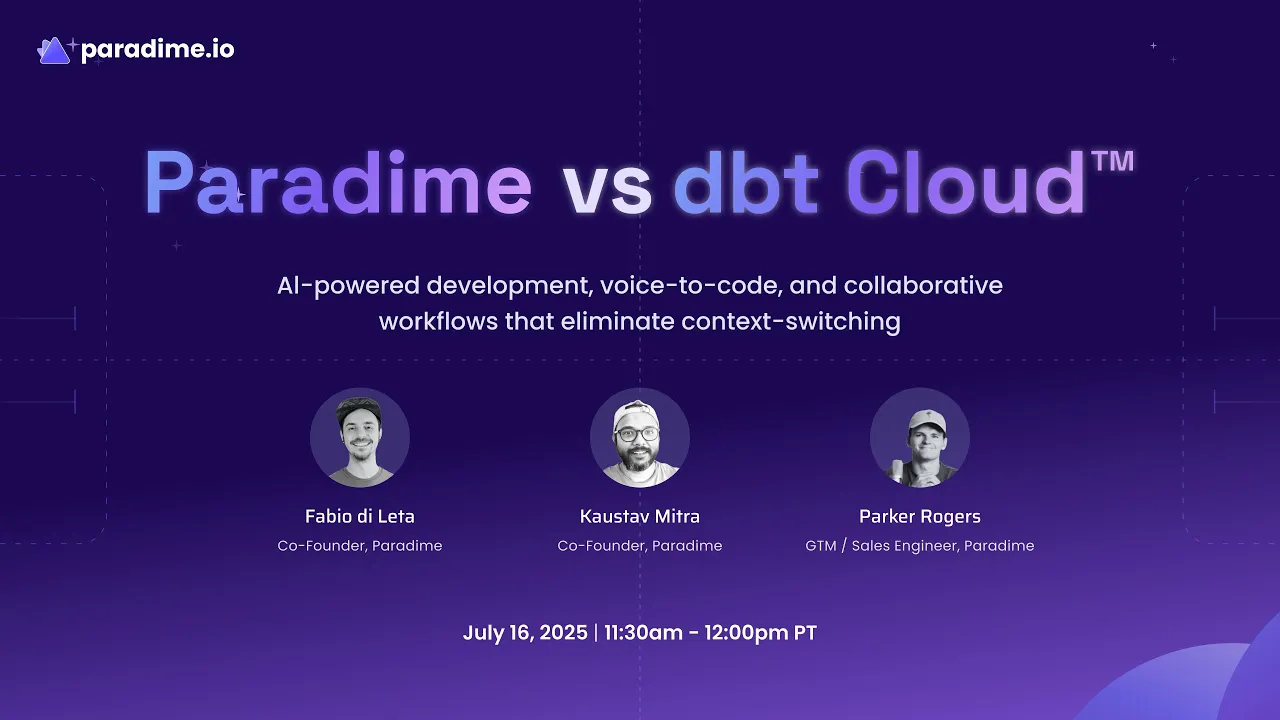
Paradime is an AI-powered workspace for analytics teams that consolidates the entire analytics workflow into one platform. Built as a modern alternative to dbt Cloud, Paradime eliminates tool sprawl and context-switching while delivering 10x faster shipping speeds and 50-83% productivity gains. With features like DinoAI co-pilot for intelligent code assistance, Paradime Bolt for production-grade orchestration, and column-level lineage from source to BI, Paradime empowers high-velocity data teams to ship faster, reduce warehouse costs by 20%+, and maintain 100% uptime for mission-critical pipelines.
Understanding Production Orchestration for dbt
What is Production Orchestration?
Production orchestration refers to the automated coordination and management of data transformation workflows in live environments. For dbt teams, this means scheduling models to run at specific times, managing dependencies between transformations, monitoring pipeline health, and ensuring data freshness for downstream consumers. Unlike development environments where data professionals iterate and test, production orchestration handles the mission-critical pipelines that power business intelligence dashboards, operational reports, and data-driven decision making.
Why Production Orchestration Matters for Data Teams
The stakes are high when production pipelines fail. A single outage can cascade across an organization, leaving executives without key metrics, sales teams without updated dashboards, and customers facing degraded experiences. Modern data teams require orchestration platforms that not only execute scheduled jobs reliably but also provide intelligent debugging when issues arise, proactive monitoring to prevent failures, and seamless integrations with enterprise tooling. The difference between basic scheduling and sophisticated orchestration often translates directly to hours saved in incident response and thousands of dollars in prevented downtime costs.
Key Requirements for Enterprise-Grade Orchestration
Enterprise teams need orchestration platforms that deliver five critical capabilities: flexible scheduling that accommodates global teams and regulatory requirements, rapid error resolution with actionable debugging information, proactive monitoring with SLA-based alerts, near-perfect uptime to support mission-critical workflows, and comprehensive integrations with existing enterprise tooling ecosystems. These requirements separate basic job schedulers from production-grade orchestration platforms designed to handle the complexity and scale of modern data operations.
Scheduling: UI-Based vs Code-Based Approaches
Paradime Bolt's Dual Scheduling Strategy
Paradime Bolt delivers unprecedented scheduling flexibility through its dual-mode approach. Teams can create UI-based schedules in seconds for rapid deployment—perfect for iterative development and quick adjustments. Simultaneously, Bolt supports code-based configurations stored in version control, enabling GitOps workflows that satisfy regulatory compliance requirements and audit trails. This architectural choice recognizes that different scheduling scenarios demand different approaches: a data analyst might need to quickly adjust a dashboard refresh schedule through a visual interface, while a compliance-focused enterprise team requires infrastructure-as-code for every production change.
Bolt's timezone-aware scheduling ensures global teams can coordinate pipelines across regions without manual timezone calculations. Whether scheduling a model to run at 9 AM local time across multiple offices or coordinating dependent pipelines across continents, Paradime handles the complexity automatically.
dbt Cloud's Basic Cron Configurations
dbt Cloud provides basic cron-based scheduling that covers fundamental use cases but struggles to accommodate enterprise requirements as teams scale. The platform's scheduling interface offers standard cron syntax for timing jobs, but lacks the sophisticated features that production teams need: no native timezone awareness beyond UTC conversions, limited options for rapid schedule modifications, and an approach that pushes teams toward third-party orchestration tools like Airflow or Prefect when complexity increases.
GitOps Workflow and Regulatory Compliance
For regulated industries including healthcare, finance, and government sectors, every production configuration change must be auditable, reviewed, and version-controlled. Paradime Bolt's code-based scheduling satisfies these requirements by treating schedules as infrastructure-as-code. Changes flow through standard pull request workflows, creating automatic audit trails and enabling multi-level approval processes. This approach transforms production scheduling from a point-and-click operation into a governed, traceable process that satisfies SOC 2, HIPAA, and other compliance frameworks.
Rapid Deployment with UI-Based Schedules
Despite the importance of GitOps for certain workflows, UI-based scheduling remains critical for development velocity. Paradime recognizes that data teams need both approaches. When a stakeholder requests an urgent dashboard update or a pipeline needs immediate adjustment to accommodate changing business requirements, waiting for code review bottlenecks introduces unacceptable delays. Bolt's UI scheduling enables authorized team members to make approved changes in seconds while maintaining appropriate access controls and change logging.
AI-Powered Debugging vs Generic Error Logs
How Paradime's DinoAI Transforms Error Resolution
When production dbt pipelines fail at 3 AM, the difference between generic error logs and AI-powered debugging determines whether teams resolve issues in minutes or hours. Paradime's DinoAI analyzes console output automatically and delivers human-readable summaries with specific remediation steps. Instead of parsing hundreds of lines of SQL compilation errors, data engineers receive actionable guidance: "There's an invalid column reference in your staging model. Check line 15 where 'customer_id' is referenced—this column doesn't exist in the source table."
This AI-powered approach reduces mean time to recovery (MTTR) by 70% compared to manual log parsing. DinoAI understands dbt-specific error patterns, database-specific syntax issues, and common configuration mistakes, providing context-aware debugging that accelerates resolution even for junior team members unfamiliar with specific parts of the codebase.
Mean Time to Recovery (MTTR) Comparison
MTTR represents one of the most critical operational metrics for data teams. When pipelines fail, every minute of downtime delays business decisions and erodes stakeholder trust. Traditional debugging workflows in dbt Cloud require engineers to: receive a generic failure notification, navigate to the job logs, search through console output for error indicators, identify the root cause, develop a fix, test the solution, and redeploy.
Paradime's AI-powered debugging compresses this workflow dramatically. The platform automatically analyzes failures, surfaces the specific issue with line numbers and context, suggests remediation steps, and enables engineers to implement fixes with confidence. This architectural advantage translates to production incidents resolved in 15-20 minutes instead of hours, protecting data quality SLAs and minimizing business impact.
Real-World Debugging Examples
Consider a common scenario: a dbt model fails because an upstream data source schema changed overnight. In dbt Cloud, the notification simply states "Job failed" with timestamps and generic error codes. Engineers must dig through logs, identify which model failed, determine why it failed, trace the schema change to its source, update model definitions, and coordinate fixes.
With Paradime's DinoAI, the failure notification includes intelligent analysis: "Model fct_orders failed due to missing column order_status. The upstream raw_orders table schema changed at 2:47 AM, removing this column. Review line 23 of your model and update the column reference." This specificity accelerates debugging exponentially, especially for large teams managing hundreds of models.
The Cost of Manual Log Parsing in dbt Cloud
Manual debugging carries hidden costs beyond delayed incident resolution. Senior data engineers spend valuable time troubleshooting issues that AI could diagnose automatically. Junior team members face steeper learning curves when cryptic error messages lack context. On-call rotations become more burdensome when every failure requires deep log analysis. These operational inefficiencies compound over time, degrading team morale and diverting resources from higher-value development work.
Monitoring and Alerting Capabilities
SLA Threshold Alerts and Proactive Monitoring
Traditional alerting systems notify teams after failures occur—a reactive approach that guarantees some level of business impact before engineers can respond. Paradime Bolt implements proactive SLA threshold monitoring that detects anomalies before they become failures. If a pipeline that typically completes in 15 minutes suddenly runs for 25 minutes, Bolt triggers alerts immediately, enabling teams to investigate performance degradation before SLA breaches occur.
This proactive approach transforms incident management from firefighting to prevention. Teams can identify queries that need optimization, catch inefficient model logic before it impacts production dashboards, and maintain consistently high performance for downstream consumers.
Paradime's Advanced Alert System
Bolt's alerting architecture integrates intelligent analysis with flexible notification routing. Alerts include not just failure status but contextual information about what failed, potential causes, and recommended next steps. The system supports sophisticated routing rules: critical pipeline failures trigger PagerDuty incidents that wake on-call engineers, performance warnings send Slack messages to optimization teams, and scheduled maintenance windows suppress non-critical notifications automatically.
This intelligence prevents alert fatigue—the phenomenon where too many low-priority notifications cause teams to ignore all alerts. By providing actionable, contextual information through appropriate channels, Paradime ensures alerts drive immediate, effective responses.
dbt Cloud's Basic Notification Approach
dbt Cloud's notification system follows a simpler model: jobs succeed or fail, and the platform sends email or webhook notifications with basic status information. While functional for small teams with simple pipelines, this approach scales poorly as organizations grow. The notifications lack contextual intelligence about failure causes, provide no performance anomaly detection, and offer limited routing flexibility for different alert types.
Teams often supplement dbt Cloud notifications with third-party monitoring tools, introducing additional complexity and cost to their data stack. The lack of native, sophisticated alerting becomes a forcing function toward more complex multi-tool architectures.
Preventing Failures Before They Happen
The most effective incident management strategy prevents failures entirely. Paradime's monitoring capabilities enable this through continuous performance tracking, automatic detection of degrading queries, identification of models approaching warehouse timeout limits, and early warning systems for data quality anomalies. By surfacing these insights proactively, Bolt empowers teams to maintain consistently high reliability without constant manual monitoring.
Uptime and Reliability Analysis
Paradime's 100% Uptime Track Record
Uptime represents the foundation of production orchestration reliability. Paradime has achieved 100% uptime over the last 90 days, with some customers reporting over 365 days without a single outage. The platform's last recorded incident occurred in October 2023 and lasted just 40 minutes—a track record that demonstrates architectural maturity and operational excellence.
This reliability enables data teams to commit to aggressive SLAs with business stakeholders. When the orchestration platform itself never fails, teams can focus on optimizing their pipelines and data quality rather than maintaining contingency plans for platform outages.
dbt Cloud's Reliability Challenges
While dbt Cloud has improved reliability over time, the platform has experienced notable incidents that disrupted customer workflows. The architectural constraints of retrofitting orchestration capabilities onto an initially IDE-focused platform create inherent reliability challenges. Competitors in the space struggle to maintain even 99% reliability—a seemingly small difference that translates to over 7 hours of potential downtime annually.
For enterprises running mission-critical pipelines that power operational decision-making, this reliability gap represents unacceptable risk. A single outage during quarter-end reporting or peak business hours can have cascading impacts across an organization.
Architecture Differences: Kubernetes vs Retrofitted Tools
Paradime Bolt's reliability advantage stems from architectural decisions made specifically for production orchestration. Built on Kubernetes from the ground up, Bolt inherits enterprise-grade container orchestration, automatic failover capabilities, horizontal scaling under load, and battle-tested infrastructure patterns from the cloud-native ecosystem.
This contrasts with platforms that added orchestration features to existing tools designed primarily for development and IDE experiences. Retrofitting production capabilities onto development-focused architecture introduces complexity, technical debt, and reliability risks that manifest as customer-facing outages.
Impact of Downtime on Production Pipelines
When orchestration platforms fail, the consequences ripple across organizations immediately. Scheduled pipelines don't run, leaving dashboards stale with outdated data. Business users lose confidence in analytics outputs and revert to manual processes. Data teams spend hours catching up on missed pipeline runs while simultaneously troubleshooting the underlying platform issues. For organizations that have invested heavily in data-driven culture, platform downtime undermines months or years of adoption efforts.
The economic impact extends beyond immediate operational disruption. Executive decisions delay while waiting for updated metrics. Customer-facing analytics features degrade. Data engineering teams burn credibility with stakeholders. These costs far exceed the price differences between orchestration platforms, making reliability the paramount consideration for production environments.
Beyond dbt: Comprehensive Workflow Orchestration
Python Command Support
Modern data workflows extend well beyond dbt transformations. Python scripts handle custom data science operations, API integrations, data quality checks, and ML model training pipelines. Paradime Bolt natively supports Python commands within the same orchestration framework, enabling teams to build end-to-end workflows without external orchestrators.
This integrated approach eliminates the architectural complexity of coordinating between dbt Cloud for SQL transformations and separate tools like Airflow or Prefect for Python operations. Teams define entire workflows in a single platform, simplifying dependency management and reducing operational overhead.
External Command Integration (Power BI, Tableau)
Data pipelines don't end when transformations complete—downstream BI tools need refreshed datasets to reflect updated analytics. Bolt provides native integrations for triggering Power BI dashboard refreshes, Tableau extract updates, and other BI tool operations directly within pipeline workflows.
This eliminates the manual coordination where data teams notify BI teams that fresh data is available, or the brittle approaches where BI tools poll for updates on fixed schedules regardless of pipeline completion. Bolt's event-driven approach ensures BI assets refresh immediately when source data updates, maintaining data freshness while minimizing unnecessary compute costs.
Reverse ETL Syncs
Reverse ETL—the process of syncing transformed data from warehouses back to operational systems like CRMs and marketing platforms—represents a critical workflow for modern data teams. Paradime Bolt orchestrates these operations natively, triggering reverse ETL syncs to tools like Salesforce, HubSpot, and Marketo as pipeline steps.
This integration creates closed-loop data workflows where insights generated in the warehouse automatically flow back to operational teams, enabling marketing personalization, sales intelligence, and customer success workflows powered by analytics.
Multi-Tool Pipeline Management
Enterprise data stacks inevitably span multiple tools, each serving specific purposes. Rather than forcing teams into single-platform architectures, Paradime Bolt embraces multi-tool reality by providing orchestration capabilities that coordinate across platforms. Teams can trigger Fivetran ingestions, run dbt transformations, execute Python data quality checks, refresh BI dashboards, and sync results to operational systems—all within unified workflows managed through Bolt's interface.
Enterprise Integration Ecosystem
Native Ticketing Integrations (Jira, Linear, Azure DevOps)
When production pipelines fail, data teams need immediate ticket creation in their project management systems for tracking, prioritization, and resolution coordination. Paradime provides native integrations with Jira, Linear, and Azure DevOps that automatically create tickets when jobs fail, including contextual information about the failure, affected models, and debugging insights from DinoAI.
This automation eliminates manual ticket creation overhead and ensures no failures slip through the cracks during busy periods. Teams maintain comprehensive incident histories in their standard project management tools without additional process overhead.
Observability Platform Connections (PagerDuty, Datadog, New Relic)
Enterprise operations teams rely on centralized observability platforms for monitoring across their entire technology stack. Paradime's native integrations with PagerDuty, Datadog, New Relic, and incident.io ensure data pipeline failures trigger the same incident management workflows as application outages or infrastructure issues.
This integration elevates data operations to the same operational rigor as software engineering teams, with on-call rotations, escalation policies, and incident response playbooks supporting mission-critical pipelines. For organizations treating data as infrastructure, these connections are non-negotiable requirements.
Automated Incident Management
Beyond simple alerting, Paradime's incident management integrations support sophisticated workflows. Failed pipelines automatically create PagerDuty incidents that route to on-call engineers, escalate to secondary responders if unacknowledged, and integrate with status page systems to communicate outages to internal stakeholders. When combined with DinoAI's intelligent debugging, this automation dramatically accelerates incident response.
Slack and Communication Tool Integration
Real-time team communication through Slack remains central to modern data team operations. Paradime provides flexible Slack integrations that notify channels about job completions, failures, and performance anomalies. Teams can customize notification rules to balance information sharing with notification overload, ensuring critical alerts reach appropriate audiences while routine successes remain visible without disrupting workflow.
Making the Switch: Migration Considerations
Migration Timeline and Process
Paradime has engineered migration from dbt Cloud to be remarkably straightforward. The platform offers one-click production job migration that imports existing dbt Cloud schedules, connection configurations, and project structures automatically. Most teams complete technical migration in under a week, with new workspaces operational in minutes rather than days or weeks.
The streamlined process reflects Paradime's understanding that migration friction represents the primary barrier preventing teams from adopting superior platforms. By minimizing technical complexity and providing comprehensive documentation, Paradime reduces migration risk to acceptable levels even for large enterprises.
Cost Comparison and ROI Analysis
dbt Cloud's pricing model often pushes growing teams toward expensive Enterprise tiers to access basic production features. Paradime offers predictable pricing aligned to business value rather than arbitrary seat counts or model execution limits. Teams typically realize immediate cost savings while gaining access to advanced features like AI-powered debugging, comprehensive lineage, and sophisticated orchestration capabilities.
The ROI extends beyond direct platform costs. Reduced MTTR translates to fewer hours spent on incident response. Improved uptime prevents business disruption costs. Integrated workflows eliminate the need for supplementary orchestration and monitoring tools. Faster development through DinoAI assistance enables teams to deliver more value with existing headcount. These compounding benefits often exceed the direct cost savings from more favorable pricing.
Team Onboarding and Training
Despite Paradime's advanced capabilities, the learning curve remains manageable for teams familiar with dbt Cloud. The platform's interface follows familiar patterns for defining models, running pipelines, and reviewing results. Paradime provides comprehensive documentation, video tutorials, and responsive support to accelerate onboarding.
Most teams achieve full productivity within two weeks of migration, with development workflows often becoming more efficient immediately due to features like real-time impact analysis and intelligent code assistance.
Risk Mitigation Strategies
For enterprises concerned about migration risk, Paradime supports phased approaches. Teams can migrate non-critical pipelines first to build confidence with the platform before transitioning mission-critical workflows. Parallel running during transition periods ensures business continuity even if unexpected issues arise. Paradime's customer success teams provide hands-on migration support for Enterprise customers, further reducing risk for complex environments.
Conclusion
Key Takeaways from the Comparison
The comparison between Paradime Bolt and dbt Cloud reveals fundamental differences in platform capabilities for production orchestration. Paradime delivers superior scheduling flexibility through dual UI and code-based approaches, dramatically faster error resolution via AI-powered debugging, proactive monitoring with SLA threshold alerts, and proven 100% uptime that outpaces competitors. The platform's comprehensive enterprise integrations and support for multi-tool workflows position it as a complete orchestration solution rather than a basic job scheduler.
Which Platform is Right for Your Team?
Teams choosing between platforms should prioritize production reliability and operational efficiency. If your organization runs mission-critical pipelines where downtime carries significant business costs, requires rapid incident response with minimal MTTR, needs sophisticated monitoring and alerting beyond basic notifications, operates in regulated industries requiring GitOps workflows and audit trails, or manages complex multi-tool data stacks extending beyond dbt—Paradime Bolt addresses these requirements comprehensively.
Smaller teams with simple pipelines and minimal production requirements may find dbt Cloud's basic orchestration sufficient, though the cost and capability advantages of Paradime often justify migration even for less complex environments.
Next Steps and Getting Started
Organizations interested in exploring Paradime can compare detailed feature matrices at paradime.io/paradime-vs-dbt-cloud, review transparent pricing at paradime.io/pricing, and schedule demos to see the platform in action. With migration timelines under one week and one-click job imports, the transition risk remains minimal compared to the operational benefits of AI-powered debugging, proven uptime, and enterprise-grade orchestration capabilities.


