Introduction
In today's data-driven landscape, analytics teams face a common challenge: tool sprawl. Data professionals juggle multiple platforms for transformation, testing, documentation, and orchestration—leading to context switching, slower development cycles, and mounting operational complexity. Enter Paradime, an AI-powered workspace often described as "Cursor for Data" that consolidates analytics workflows into a single platform.
Paradime eliminates the inefficiencies that plague modern data teams by unifying development, orchestration, and monitoring capabilities. With its Code IDE that accelerates dbt development, DinoAI co-pilot for intelligent SQL and documentation assistance, and Paradime Bolt for production orchestration, organizations report impressive results: 50-83% productivity gains, 25-50% faster development cycles, and 20%+ reductions in warehouse costs. For analytics engineers seeking to transform raw data into reliable, actionable insights, Paradime represents a fundamental shift in how data transformation workflows operate.
What is Analytics Engineering?
The Evolution of Data Roles
Analytics engineering has emerged as a critical discipline that bridges the gap between data engineering and business intelligence. While data engineers focus on building infrastructure—extracting data from various sources and loading it into warehouses—and data analysts concentrate on deriving insights from prepared datasets, analytics engineers occupy the crucial middle ground.
Traditional data analysts historically pulled data, analyzed trends, and generated insights using tools like Excel and Looker. Analytics engineers, however, spend their time transforming, testing, deploying, and documenting data. They apply software engineering best practices—version control, continuous integration, modular code design—to the analytics codebase itself.
Unlike data engineers who typically work with production-level Python code to build data pipelines, analytics engineers primarily use SQL and tools like dbt to create clean, well-structured data models. Their work enables self-service analytics by preparing data sets that business users can confidently query without constant technical support.
Why Analytics Engineering Matters
The analytics engineering discipline addresses several critical challenges in modern data operations. First, it dramatically improves data quality and reliability. By implementing systematic testing, documentation, and validation at the transformation layer, analytics engineers catch data issues before they cascade into broken dashboards and incorrect business decisions.
Second, analytics engineering enables true self-service analytics. When data is properly modeled, documented, and organized with clear naming conventions, business users can answer their own questions without waiting for technical teams. This democratization of data access accelerates decision-making across organizations.
Finally, analytics engineering allows data transformation workflows to scale efficiently. By applying software engineering principles—modular design, version control, automated testing—teams can manage increasingly complex data environments without proportionally increasing headcount or sacrificing quality.
Paradime: Your Analytics Engineering Platform
Core Features and Capabilities
Paradime brings together the essential tools analytics engineers need into one cohesive platform. The Code IDE provides an AI-native development environment for dbt and Python, with full context of your data, documentation, and related work items. This eliminates the constant switching between terminals, text editors, documentation sites, and data warehouse interfaces.
DinoAI, Paradime's integrated AI assistant, transforms how analytics engineers work. Operating in two modes—Agent Mode for implementing changes directly and Ask Mode for guidance—DinoAI understands your dbt project structure, data warehouse schema, and analytics engineering best practices. It generates SQL, creates documentation, applies consistent standards across codebases, and answers technical questions without ever leaving your development environment.
Paradime Bolt handles production orchestration with declarative scheduling, automated pipelines, and robust monitoring. It supports various trigger types (scheduled runs, on-completion chains, on-merge deployments), integrates with version control platforms for CI/CD, and provides SLA threshold alerts to maintain data freshness. Column-level lineage tracking helps teams understand data dependencies, while native integrations with Looker, Tableau, and other BI tools complete the analytics stack.
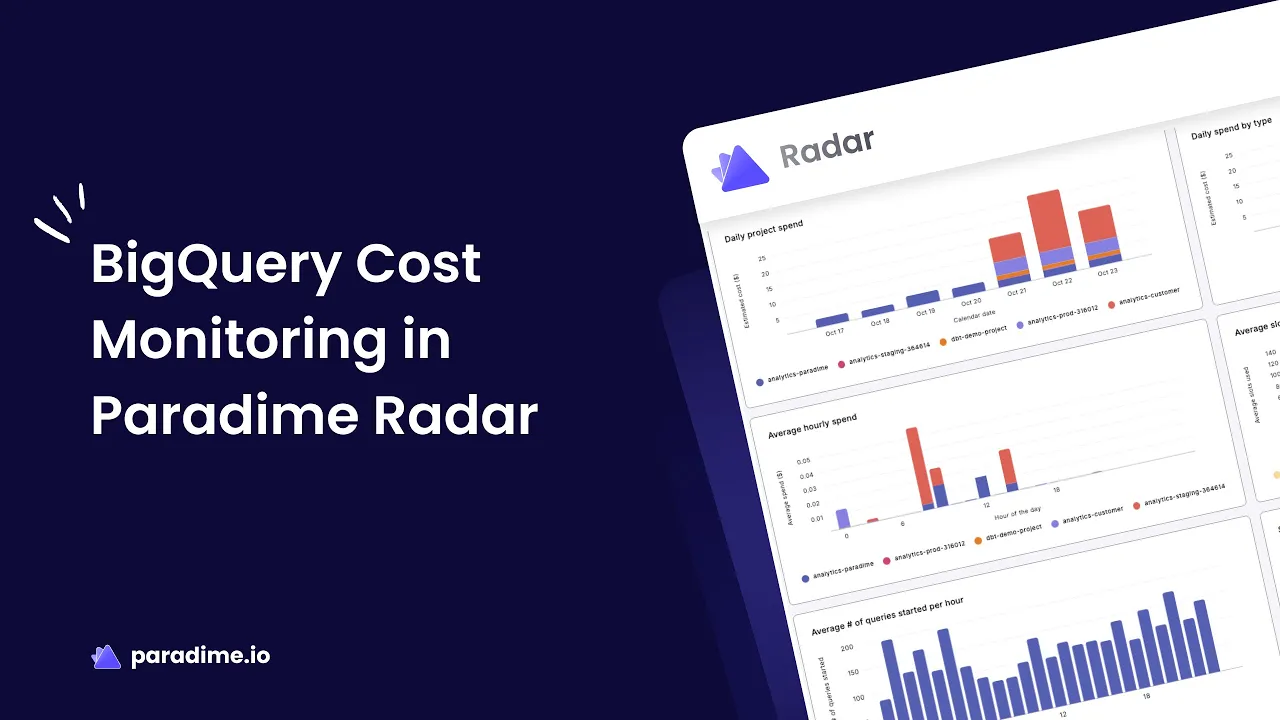
Additional platform capabilities include Paradime Radar for FinOps optimization to reduce Snowflake and BigQuery costs, data samples viewable directly in the interface, and enterprise-grade security with SOC 2 Type II compliance and 99.9% uptime guarantee.
How Paradime Transforms Workflows
The productivity gains Paradime delivers aren't incremental improvements—they're transformational. Teams report reducing tasks that previously took 4 hours down to just 5 minutes. Error resolution time drops from 30 seconds to 10 seconds, representing a 70% speed boost. Development cycles accelerate by 25-50%, and deployment speed increases by 50%.
These improvements stem from eliminating the friction that accumulates across traditional analytics workflows. When developers can write SQL, test changes, view data lineage, generate documentation, and deploy to production—all within a single interface with AI assistance—the cumulative time savings become massive.
Real customer outcomes illustrate this transformation. Motive achieved 10x productivity acceleration. PushPress built their AI-powered data platform with 3x efficiency. Emma cut pipeline runtime in half. Teams consistently report shifting from spending 70% of time on bug tickets to just 20%, freeing engineers to focus on feature development that drives business value.
Getting Started with dbt in Paradime
Setting Up Your Environment
Beginning your analytics engineering journey in Paradime starts with workspace configuration. Connect your data warehouse—whether Snowflake, BigQuery, Redshift, or another supported platform—through Paradime's connection interface. The platform handles authentication securely while giving you immediate access to query your data.
Next, establish your repository setup and version control. Paradime integrates seamlessly with Git-based platforms, allowing you to import existing dbt projects or initialize new ones. This version control foundation ensures all transformation logic is tracked, changes are reviewable, and team collaboration follows software engineering best practices.
Workspace configuration extends to team permissions, environment variables, and deployment targets. Paradime's interface makes these typically complex setup tasks straightforward, getting teams productive quickly rather than spending days on configuration.
Building Your First dbt Models
Understanding dbt project structure is fundamental to effective analytics engineering. Projects organize into layers: sources (raw data), staging (cleaned and standardized), intermediate (business logic transformations), and marts (final tables optimized for specific business use cases).
Writing modular SQL transformations means creating models that do one thing well and reference each other using dbt's ref() macro. This approach creates clear dependencies, enables selective rebuilding, and makes logic easier to test and maintain. For example, instead of one massive query joining dozens of tables, you build layers: staging models that clean individual sources, intermediate models that implement specific business logic, and mart models that combine everything for analysis.
Best practices for model organization include clear naming conventions (e.g., stg_salesforce__accounts, int_orders__enriched, mart_finance__revenue), consistent materialization strategies (views for lightweight transformations, tables for frequently queried datasets, incremental models for large event streams), and logical folder structures that mirror your business domains.
Testing and Documentation
Data quality tests are non-negotiable in production analytics. dbt makes testing straightforward with schema tests (unique, not_null, accepted_values, relationships) defined directly in YAML files alongside your models. Custom tests using SQL queries address business-specific validation rules.
Documentation transforms from an afterthought into a first-class workflow component with DinoAI. The AI assistant auto-generates descriptions for models, columns, and metrics based on the SQL logic and existing documentation patterns. This ensures every dataset has context that helps business users understand what the data represents and how to use it correctly.
Maintaining data contracts—explicit agreements about data structure, freshness, and quality—becomes practical with Paradime's testing and monitoring capabilities. When contracts are violated, teams receive immediate alerts rather than discovering issues through broken dashboards or incorrect reports.
Advanced Analytics Engineering Practices
Optimizing dbt Performance
Incremental models represent a superpower for analytics engineers managing large datasets. Rather than rebuilding entire tables on every run, incremental models process only new or changed records. This dramatically reduces transformation runtime and warehouse compute costs, especially for event-stream data or slowly-changing dimensions.
However, incremental models require careful handling. You must define unique keys for merge/upsert operations, handle late-arriving data appropriately, and choose the right incremental strategy (append, merge, delete+insert) for your use case. Paradime's AI assistance helps navigate these complexities by suggesting optimal approaches based on your data patterns.
Query optimization techniques focus on reducing unnecessary computation. Push filters earlier in transformation chains. Use appropriate join types. Avoid SELECT * in production models. Leverage warehouse-specific features like clustering keys or partition pruning. Paradime's column-level lineage helps identify where optimizations will have the greatest impact.
Warehouse cost reduction strategies combine technical and organizational approaches. Materialize frequently-queried datasets as tables while keeping lightly-used transformations as views. Set appropriate retention policies for intermediate results. Use Paradime Radar to identify expensive queries and optimize them proactively.
CI/CD and Production Orchestration
Declarative scheduling with Paradime Bolt moves beyond cron jobs to intelligent orchestration. Define dependencies between dbt runs, Python scripts, and downstream processes. Chain transformations so marts rebuild automatically when upstream staging models complete. Trigger CI checks on every pull request to catch issues before they reach production.
Automated testing and deployment workflows ensure code quality without manual intervention. When developers merge changes to the main branch, Paradime can automatically run full test suites, deploy to production environments, and notify relevant stakeholders of successful deployments or failures requiring attention.
Monitoring and alerting best practices include setting SLA thresholds for critical datasets, configuring notifications to appropriate channels (Slack, email, Teams), and establishing clear escalation paths when issues occur. Real-time monitoring catches problems immediately rather than waiting for business users to report broken dashboards.
Data Lineage and Governance
Column-level lineage tracking in Paradime shows exactly how each field in your final datasets derives from source systems. This granular visibility is invaluable for impact analysis (what breaks if we change this source field?), compliance requirements, and debugging data quality issues.
Real-time monitoring and alerts keep teams informed about transformation health. When models fail, data freshness SLAs are missed, or tests detect quality issues, notifications route to the right people immediately. This proactive approach minimizes downtime and maintains stakeholder trust.
Ensuring data quality at scale requires systematic approaches rather than ad-hoc fixes. Establish testing standards that all models must meet. Use dbt packages for common validation patterns. Leverage Paradime's .dinorules to enforce consistent standards across your entire project automatically.
Maximizing Productivity with AI
DinoAI Features and Use Cases
SQL query generation with DinoAI accelerates development from blank page to working transformation. Describe what you want in natural language—"create a model showing monthly recurring revenue by customer segment"—and DinoAI generates the SQL foundation, understanding your table structures, naming conventions, and common patterns.
Automated documentation eliminates the tedious work of describing every model and column. DinoAI analyzes your SQL logic, existing documentation, and business context to generate accurate, helpful descriptions. This transforms documentation from a backlog item into an automatic byproduct of development.
Code suggestions and optimization happen in real-time as you work. DinoAI identifies performance improvements, catches potential errors before you run code, and suggests more efficient approaches based on best practices and your specific data warehouse platform.
Custom AI Workflows
.dinorules and .dinoprompts enable teams to standardize how DinoAI operates across projects. Define organizational conventions—SQL formatting preferences, documentation requirements, naming standards, testing thresholds—and DinoAI enforces them automatically. This ensures consistency even as teams scale and new members join.
Team-specific AI configurations adapt DinoAI's behavior to your unique requirements. If your organization has specific terminology, business logic patterns, or compliance requirements, configure DinoAI to incorporate this context into every suggestion and generation.
Precision AI help with targeted line context means DinoAI understands exactly what you're working on. Rather than generic responses, the assistant provides relevant suggestions based on your current model, the tables you're referencing, and the transformation logic you're implementing.
Real-World Success Stories
Team Productivity Improvements
Organizations implementing Paradime consistently report 50-83% productivity gains. These aren't marginal improvements—they represent fundamental transformations in how analytics engineering work gets done. Teams that previously spent the majority of their time on infrastructure, tooling friction, and bug fixes redirect that energy toward building features that drive business outcomes.
Faster time-to-insight for stakeholders compounds these internal efficiency gains. When analytics engineers can develop and deploy transformations 25-50% faster, business teams get answers to critical questions sooner. This acceleration in the decision-making cycle creates competitive advantages that extend far beyond the data team.
Reduced engineering bottlenecks mean business units don't wait weeks for new data models or dashboard updates. Self-service analytics becomes genuinely practical when data is reliably modeled and documented. Organizations report decreased ad-hoc request volume as users confidently query prepared datasets themselves.
Cost Optimization Results
20%+ warehouse cost reductions come from multiple optimization levers Paradime enables. More efficient transformations reduce compute requirements. Better materialization strategies avoid unnecessary table rebuilds. Paradime Radar identifies expensive queries for targeted optimization. These savings directly improve the ROI of cloud data warehouse investments.
Efficient resource utilization extends beyond just compute costs. Teams accomplish more with existing headcount. Infrastructure complexity decreases. Tool licensing consolidates. The total cost of operating analytics workflows drops significantly.
ROI measurement and tracking becomes straightforward when productivity gains and cost reductions are this substantial. Organizations typically see payback periods measured in months rather than years, with ongoing benefits that compound as teams grow and data volumes scale.
Best Practices for Analytics Engineering Teams
Collaboration and Workflow
Version control strategies form the foundation of effective team collaboration. Use feature branches for development work. Require pull requests for production changes. Maintain clear commit messages that explain the business context, not just the code changes. Paradime's Git integration makes these practices seamless.
Code review processes ensure knowledge sharing and catch issues before production. Reviews should examine not just SQL correctness but also model design, test coverage, documentation quality, and performance implications. DinoAI can assist reviewers by highlighting potential issues and suggesting improvements.
Documentation standards should be explicit and enforced. Every model needs a description. Critical columns require detailed explanations. Complex business logic deserves inline comments. Paradime's automation capabilities make maintaining these standards practical rather than aspirational.
Scaling Your Analytics Practice
Building reusable data models accelerates future development. Create staging models for all important source systems. Develop intermediate models for common business logic that multiple teams need. Design mart models that serve broad analytical needs rather than one-off requests.
Creating data marts for different teams—finance, marketing, product, operations—provides each function with datasets optimized for their specific analysis patterns. This domain-oriented design improves query performance and makes data more discoverable for business users.
Maintaining data quality at scale requires automation and systematic approaches. Comprehensive test coverage catches regressions. Regular monitoring identifies emerging issues. Clear ownership models ensure someone is responsible for fixing problems when they arise.
Continuous Improvement
Monitoring key metrics keeps teams focused on outcomes that matter. Track transformation runtime, test pass rates, data freshness, warehouse costs, and stakeholder satisfaction. These measurements identify areas needing attention and validate that improvements deliver expected benefits.
Iterating on transformation logic is necessary as business requirements evolve and data volumes grow. Regularly review model performance. Refactor complex transformations into more maintainable designs. Update materialization strategies as usage patterns change.
Staying current with best practices means engaging with the analytics engineering community, following dbt Labs' evolving recommendations, and leveraging Paradime's built-in guidance. The discipline continues maturing rapidly, and teams that adapt gain competitive advantages.
Conclusion
Analytics engineering has evolved from an emerging discipline into a critical function for data-driven organizations. The challenge has always been managing the complexity of transformation workflows while maintaining quality, speed, and cost efficiency. Paradime addresses these challenges by consolidating the entire analytics engineering workflow into one AI-powered platform.
The results speak clearly: 50-83% productivity gains, 25-50% faster development cycles, 20%+ warehouse cost reductions, and fundamentally transformed team dynamics. By eliminating tool sprawl, automating tedious tasks with DinoAI, and providing robust orchestration through Bolt, Paradime enables analytics engineers to focus on what matters—building reliable data products that drive business decisions.
Getting started with Paradime means moving from fragmented tools and manual processes to an integrated, AI-assisted workflow. Whether you're building your first dbt models or scaling an enterprise analytics practice, the platform provides the capabilities needed to succeed in modern analytics engineering. The future of data transformation is consolidated, intelligent, and remarkably efficient—and it's available today.


