Introduction
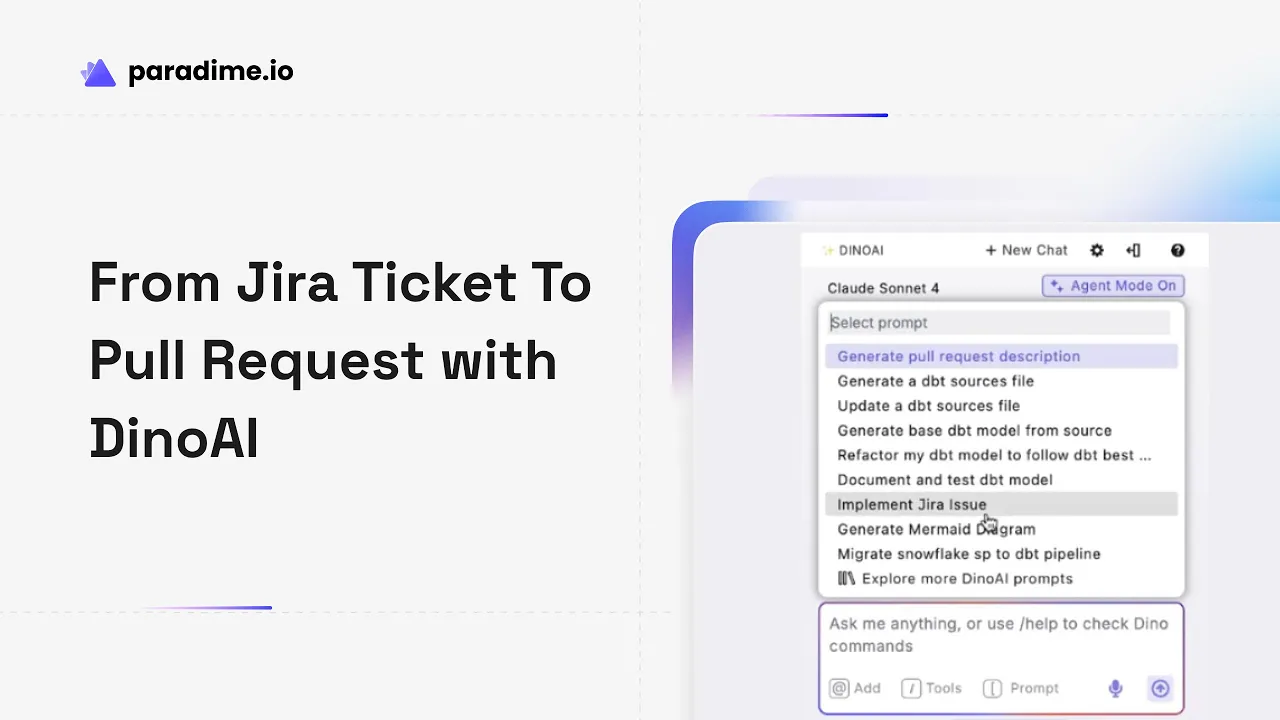
Paradime is an AI-powered workspace for analytics teams, often described as "Cursor for Data." It consolidates the entire analytics workflow into one unified platform, eliminating tool sprawl and context-switching. With features like the Code IDE powered by DinoAI (an AI co-pilot for SQL development), Paradime Bolt (production-grade orchestration), and Paradime Radar (monitoring with column-level lineage), the platform helps teams ship faster, reduce warehouse costs, and increase productivity. High-velocity companies report 10x speed improvements and 50-83% productivity gains using Paradime's intelligent automation capabilities.
What is Ticket-Based Development Automation?
The Traditional Analytics Engineering Workflow
Analytics engineers traditionally spend countless hours on repetitive tasks: manually reviewing Jira tickets, switching between tools to gather context, exploring database schemas, and writing boilerplate code. This fragmented workflow creates bottlenecks, increases error rates, and prevents teams from focusing on high-value strategic work.
The typical process involves constant context switching between project management platforms, documentation repositories, and development environments—draining productivity and extending delivery timelines.
The Vision: From Requirements to Production Code
Ticket-based development automation transforms this workflow by creating a seamless pipeline from product requirements to production-ready code. Through direct integration with project management tools like Jira, AI-powered requirement interpretation, and automated code generation that follows team standards, teams can eliminate manual grunt work while maintaining quality and consistency.
This approach builds in validation and quality checks from the start, ensuring every generated model meets your organization's standards before it reaches production.
Understanding Context Engineering in dbt Development
What is Context Engineering?
Context engineering is an advanced AI technique that eliminates repetitive prompting by creating intelligent, context-aware development workflows. Instead of manually providing background information with every request, context engineering combines multiple information layers simultaneously—enabling AI to understand your team's standards, codebase structure, and business requirements automatically.
Think of it as teaching your AI assistant to be a senior team member who already knows your conventions, understands your data warehouse, and can apply that knowledge consistently.
The Four Layers of Context Integration
Foundation Layer: .dinorules and .dinoprompts
At the foundation, .dinorules files serve as configuration documents containing your team's standards and business logic. These files embed naming conventions, coding standards, and architectural principles that DinoAI automatically applies to every generated model. Complementing this, .dinoprompts provide reusable prompt templates for common operations, ensuring consistency across different tasks.
Multi-Layer Context Integration
The second layer integrates file context (understanding your existing codebase structure), database metadata (automatically fetching schema and table information), user instructions (specific task requirements), and team rules (automated application of standards). This multi-dimensional understanding ensures AI-generated code fits seamlessly into your existing architecture.
Precision Context
Precision context enables targeted, line-level assistance within large files. Rather than overwhelming the AI with entire codebases, this layer focuses on relevant context for specific tasks, improving processing efficiency and output quality.
Enterprise System Integration
The final layer connects enterprise systems like Jira and Linear, enabling end-to-end workflow automation with seamless handoff from ticket to code. This integration closes the loop between product requirements and implementation.
Paradime's Jira to dbt Automation Workflow
Step 1: Jira Ticket Integration
The automation begins with direct connection to your Jira workspace. DinoAI automatically fetches tickets, reads specifications, and extracts context from descriptions, comments, and attachments. This eliminates manual requirement gathering and ensures no details are lost in translation.
Step 2: Autonomous Todo List Creation
Once requirements are understood, DinoAI creates its own task breakdown with intelligent step sequencing. The AI manages its own progress tracking with real-time status updates, functioning as an autonomous agent rather than a simple code generator.
Step 3: Database Metadata Fetching
DinoAI automatically connects to your data warehouse to discover schemas, extract column-level metadata, and understand relationships and lineage. This metadata forms the foundation for accurate, production-ready model generation.
Step 4: Sources and Staging Model Generation
With context established, DinoAI generates sources.yml files and staging models that adhere to your .dinorules configurations. Every model follows consistent naming conventions and structural patterns, eliminating the variability that comes with manual development.
Step 5: Schema.yml Generation
Comprehensive documentation is generated automatically, including column descriptions, business definitions, data quality tests, and validation rules. This ensures your dbt project maintains metadata-enriched specifications from day one.
Step 6: Terminal Integration and Validation
Before marking work complete, DinoAI executes automatic compilation checks and dbt tests. Error detection and debugging happen in real-time, validating code quality before human review.
Step 7: Pull Request Creation
Finally, DinoAI analyzes git diffs and generates automated PR descriptions with change summaries and impact assessments. Code arrives review-ready with documentation that helps reviewers understand exactly what changed and why.
Benefits of Automated Ticket-Based Development
Time Savings and Efficiency
Teams report 10x faster model development by eliminating grunt work and repetitive tasks. Analytics engineers shift their focus to high-value problem solving—designing data architectures, optimizing performance, and solving complex business challenges rather than writing boilerplate code.
Consistency and Quality
Automated generation ensures standardized code across the team with automatic application of best practices. Human error in boilerplate generation is virtually eliminated, improving overall code quality and reducing technical debt.
Improved Documentation
Documentation remains always up-to-date with consistent standards applied automatically. This improves knowledge sharing across teams and makes onboarding new team members significantly easier.
Enhanced Collaboration
Seamless handoff from product to engineering reduces miscommunication and rework. Clear audit trails from requirement to implementation improve transparency and accountability across the organization.
Best Practices for Implementation
Setting Up Your .dinorules File
Success starts with well-defined .dinorules. Document clear naming conventions, coding standards, patterns, business logic requirements, and testing rules. The more comprehensive your rules, the more consistent and accurate your AI-generated code will be.
Optimizing Jira Ticket Descriptions
Write detailed acceptance criteria with relevant technical specifications. Link to related documentation and tag database objects and schemas explicitly. Well-structured tickets lead to better AI interpretation and more accurate implementation.
Establishing Validation Workflows
Configure automated test suites and set up CI/CD integration with defined quality gates. Monitor generated code quality consistently and adjust .dinorules based on outcomes.
Training Your Team
Onboard developers to context engineering concepts and share .dinorules best practices. Establish clear review processes for AI-generated code and create feedback loops for continuous improvement.
Real-World Applications
New Data Model Development: Transform product requirements into dbt models in minutes with automatic adherence to standards and built-in testing.
Data Pipeline Expansion: Add new data sources with minimal effort, creating consistent staging layers with automated lineage tracking.
Technical Debt Reduction: Retrofit documentation to existing models, standardize legacy code, and improve test coverage across projects systematically.
Cross-Team Collaboration: Enable product managers to create technical tickets, data analysts to request datasets, and business users to specify transformations—all without deep dbt expertise.
The Future of Analytics Engineering Automation
The trajectory is clear: deeper integration with enterprise tools, enhanced AI understanding of business context, and self-optimizing pipelines. AI agents will evolve beyond code generation to autonomous debugging, continuous learning from team patterns, and proactive optimization recommendations.
Future capabilities include automated data quality monitoring, AI-powered incident response, intelligent query optimization, and self-healing data pipelines that detect and resolve issues before they impact end users.
Getting Started with Paradime's Jira Integration
Prerequisites
You'll need a Paradime account and workspace, Jira workspace with appropriate permissions, a dbt project connected to Paradime, and configured data warehouse credentials.
Initial Setup
Connect your Jira workspace to Paradime
Configure
.dinorulesfile with team standardsSet up database connections and metadata access
Create test Jira tickets with detailed requirements
Run your first automated workflow
Tips for Success
Start with simple, well-defined tickets to build confidence. Iterate on .dinorules based on output quality, reviewing and refining AI-generated code initially. As quality improves, gradually scale to more complex workflows.
Conclusion
Automated ticket-based development represents a paradigm shift in analytics engineering, moving teams from manual, repetitive coding to intelligent, context-aware automation. Paradime's integration of Jira with DinoAI demonstrates how context engineering transforms product requirements into production-ready dbt models with minimal human intervention.
By eliminating grunt work, enforcing standards, and maintaining comprehensive documentation, this approach allows analytics engineers to focus on solving complex business problems rather than writing boilerplate code. As AI agents become more sophisticated, the gap between requirement and implementation continues to shrink—making high-quality data development accessible to teams of all sizes and unlocking unprecedented productivity gains in the analytics engineering workflow.


