Introduction
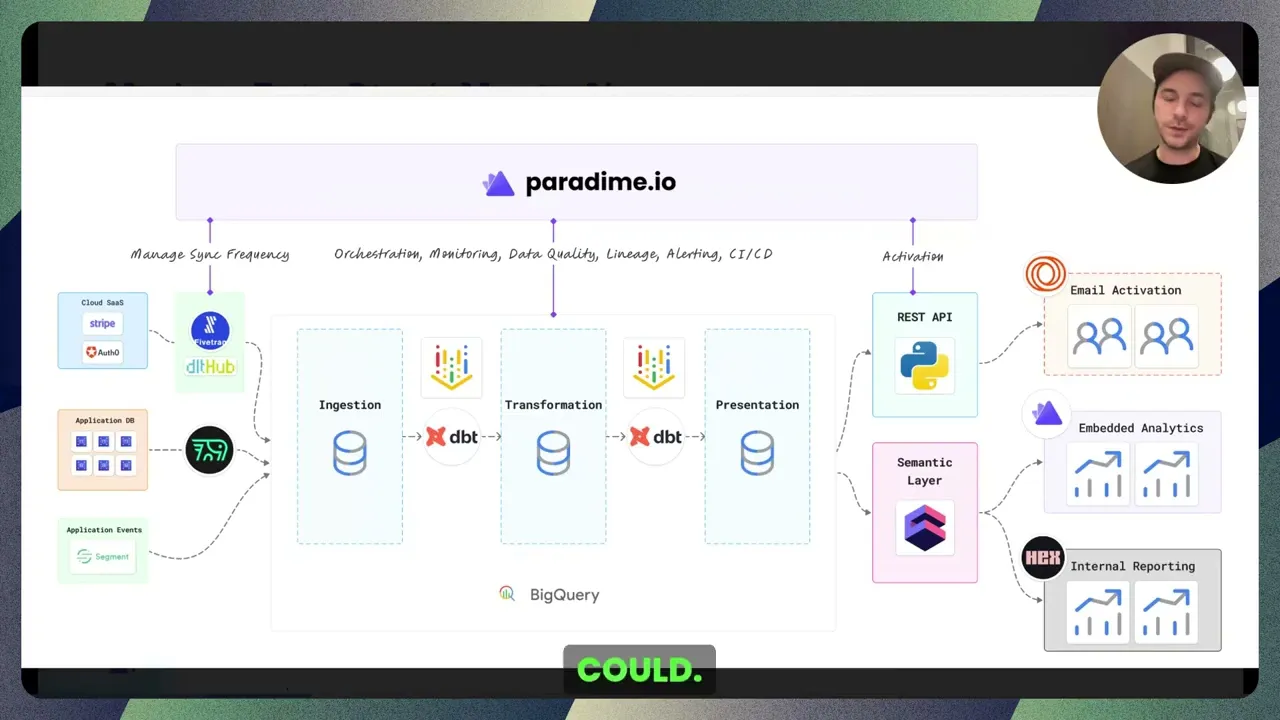
Paradime is an AI-native data platform designed to revolutionize analytics engineering workflows. As a comprehensive workspace that consolidates the entire analytics lifecycle, Paradime accelerates development speed through its powerful Code IDE, DinoAI co-pilot, and production-grade dbt™ orchestration with Bolt. The platform eliminates rote work and cuts dbt™ and Python development time by up to 83%, enabling analytics engineers to work ridiculously fast with full context of data, documentation, and tickets. With DinoAI integrated directly into the development environment, teams can maintain focus without context-switching, while Bolt orchestration provides a configure-and-forget experience that reduces error resolution time by 70%. This powerful combination transforms how data teams build, deploy, and maintain their analytics infrastructure.
Understanding the Semantic Layer
What is a Semantic Layer?
A semantic layer serves as a universal intermediary between your data sources and data consumers, transforming complex technical data structures into business-friendly concepts that everyone can understand. Think of it as a translation layer that sits between raw data in warehouses and the people or applications that need to use it.
Rather than forcing analysts and business users to navigate complicated database schemas, join tables, or write complex SQL, the semantic layer abstracts this complexity behind intuitive business terms and metrics. It provides a single source of truth for how data is defined, calculated, and accessed across your organization.
This abstraction creates a consistent vocabulary where "revenue," "customer lifetime value," or "active users" means exactly the same thing regardless of which tool you're using or who's asking the question.
Why Modern Data Teams Need a Semantic Layer
Today's data landscape presents unique challenges. Organizations typically juggle multiple data warehouses, lakes, and operational databases while supporting diverse consumption tools—from traditional BI platforms to custom applications and AI agents. This many-to-many relationship creates chaos.
Without a semantic layer, each BI tool or application defines metrics independently, leading to inconsistent calculations across the organization. Marketing reports different revenue figures than finance. Sales dashboards show different customer counts than customer success tools. Data teams spend countless hours reconciling discrepancies and answering "why don't these numbers match?"
A semantic layer solves these problems by centralizing business logic upstream from all consumption tools. It ensures consistency, improves data accuracy, and establishes better governance. Instead of defining "monthly recurring revenue" in five different BI tools, you define it once in the semantic layer, and every downstream application receives the same calculation.
This centralization reduces maintenance burden, accelerates time-to-insight, and builds trust in data across the organization.
Cube.dev's Four Essential Pillars
Cube's semantic layer architecture rests on four foundational pillars that work together to deliver reliable, secure, and performant analytics: data modeling, access control, caching, and APIs.
Data Modeling: The Foundation
At the heart of Cube lies a code-first, dataset-centric approach to data modeling. Unlike traditional BI tools where metrics live scattered across dashboards, Cube centralizes all metric definitions and business logic in version-controlled code—written in YAML or JavaScript.
Cube's data model works with two primary object types. Cubes represent your core business entities like customers, orders, or products. Each cube defines all calculations through measures and dimensions, along with relationships to other entities. Views sit atop this graph of cubes, creating facades that present unified datasets to data consumers.
This approach creates a knowledge graph that both AI agents and human users can navigate to understand your business. Because the model is code-first, data teams gain the benefits of software engineering best practices: version control, code review, testing, and collaborative development.
The dataset-centric design, inspired by dimensional modeling, makes it intuitive to express business logic while maintaining the flexibility to handle complex enterprise requirements.
Access Control: Security First
Security in Cube isn't an afterthought—it's fundamental to the architecture. The access control pillar ensures that every query, whether from a human analyst or an AI agent, respects your data security policies.
Cube implements comprehensive, fine-grained permissions at every level of the data modeling layer. You can control visibility and access to cubes, views, measures, and dimensions for individual users, teams, roles, or applications. The system supports row-level access control, column masking, and member-level restrictions.
For multi-tenant applications, Cube provides elaborate configuration options that ensure each tenant—whether a user, account, or organization—sees only their data. The semantic layer can intercept, inspect, and allow or disallow any query based on security policies.
Authentication leverages industry-standard JSON Web Tokens containing security context and permission claims. Cube also supports custom authentication protocols and integrates seamlessly with external providers like LDAP, Auth0, and AWS Cognito.
By centralizing access control in the semantic layer, organizations create a single governed checkpoint. All data consumption flows through consistent security policies, regardless of the downstream tool or application.
Caching: Performance Optimization
The semantic layer acts as a performance buffer between your data consumers and data sources. Without proper caching, every dashboard refresh or report query hits your data warehouse directly, creating performance bottlenecks and driving up compute costs.
Cube solves this through an aggregate awareness framework called pre-aggregations. Data teams define rollup tables in the data model, specifying which measures and dimensions to include. Cube then builds and refreshes these pre-aggregations automatically by querying your cloud data warehouse and storing optimized results in Cube Store.
Pre-aggregations can refresh on schedules or as part of orchestration workflows, ensuring data freshness aligns with business requirements. When queries arrive, Cube's aggregate awareness engine intelligently determines if an existing pre-aggregate can serve the request, delivering sub-second responses even on massive datasets.
This approach dramatically reduces query times, minimizes database load, and enables interactive analytics experiences that would otherwise be impossible. Users get the performance of a hand-tuned OLAP cube with the flexibility of querying live data.
APIs: Universal Connectivity
The final pillar—APIs—is what makes Cube truly universal. Rather than forcing organizations to adopt a specific query language or integrate through proprietary protocols, Cube speaks the languages that data tools already understand.
Cube provides multiple API options: a Postgres-compliant SQL API for BI platforms, a REST API for custom applications and embedded analytics, a GraphQL API for real-time experiences, and a DAX API for native Power BI connectivity. This multi-protocol approach ensures seamless integration with existing tools.
The API layer solves the many-to-many problem between data sources and consumption tools. Instead of building point-to-point integrations, you connect data sources to Cube once and then connect any number of downstream tools through the APIs they prefer.
All APIs leverage Cube's centralized data modeling, access control, and caching—ensuring consistent, secure, and performant data delivery regardless of how it's accessed.
Security Features Deep Dive
Granular Access Controls
Cube's security model provides unprecedented granularity in controlling data access. At the entity level, you can determine which users or roles can even see specific cubes, views, measures, or dimensions in the semantic layer.
The system goes deeper with row-level and column-level controls. Row-level security restricts which records users can access based on attributes in the security context—enabling scenarios like showing sales representatives only their own accounts, or restricting financial data to specific departments.
Column-level controls allow masking or completely hiding sensitive fields. You might show customer names to support teams but mask email addresses, or hide salary information from everyone except HR.
Cube's query interception capabilities enable custom security logic. You can inspect queries before execution, modify them to enforce additional constraints, or block them entirely based on sophisticated business rules.
The platform supports custom authentication protocols, allowing integration with any identity provider or authentication system your organization uses.
Data Governance Capabilities
By positioning the semantic layer as a centralized security checkpoint, Cube fundamentally changes how organizations approach data governance. Rather than configuring security policies separately in each BI tool or application, you define them once in Cube.
This centralization ensures consistent policy enforcement. When you update an access rule—perhaps restricting access to new PII fields—the change applies immediately across every connected tool and application.
Cube also maintains separation between access to the semantic layer and access to the physical data layer. Users query through the semantic layer without requiring direct database credentials, reducing attack surface and simplifying credential management.
Data teams gain visibility into who's accessing what data, through which tools, and when—enabling audit trails and compliance reporting that would be nearly impossible with decentralized data access.
Flexibility Through Universal Integrations
Supported Data Sources
Cube connects to the full spectrum of modern data infrastructure. For data warehouses, Cube supports industry leaders including Snowflake, Databricks, BigQuery, Redshift, Microsoft Fabric, SingleStore, Firebolt, and MotherDuck.
Query engines like ClickHouse, Apache Pinot, Presto, Trino, AWS Athena, Druid, and Hive/SparkSQL are all supported, enabling flexible compute layer choices.
Traditional transactional databases remain relevant, and Cube works with PostgreSQL, Microsoft SQL Server, MySQL, Oracle, and SQLite. For time-series workloads, QuestDB and Timescale integrate seamlessly.
Modern streaming architectures are supported through ksqlDB, Materialize, and RisingWave. Even NoSQL and document databases like Elasticsearch and MongoDB can serve as data sources.
This broad compatibility means Cube adapts to your existing infrastructure rather than forcing you to standardize on specific technologies.
BI Tools and Visualization Integrations
On the consumption side, Cube's API-first architecture enables connections to virtually any BI or visualization tool.
Enterprise BI platforms including Power BI, Tableau, ThoughtSpot, and Looker integrate natively. Modern BI tools like Sigma Computing, Amazon QuickSight, Metabase, and Superset connect easily through Cube's SQL API.
Beyond traditional BI, Cube supports spreadsheet tools like Google Sheets and Excel, enabling business users to analyze data in familiar environments. Notebook platforms including Hex, Jupyter, and Streamlit let data scientists and analysts work in their preferred tools.
Low-code platforms and internal tool builders—Retool, Appsmith, Bubble, and Budibase—can rapidly build data applications on Cube's semantic layer.
For custom development, front-end frameworks (React, Angular, Vue) and charting libraries (Chart.js, D3.js, Highcharts) integrate through Cube's REST and GraphQL APIs.
Emerging AI and LLM tools like Delphi, Athena Intelligence, Push.ai, and LangChain can leverage the semantic layer to ground their analysis in consistent, governed data.
Orchestration Integrations
Cube fits naturally into modern data orchestration workflows. Native dbt integration allows data teams to define their transformation logic in dbt while building the semantic layer in Cube, creating a cohesive analytics architecture.
Workflow orchestration platforms including Airflow, Prefect, Dagster, and Coalesce.io can trigger Cube pre-aggregation refreshes, integrate semantic layer queries into data pipelines, and coordinate complex analytics workflows.
Real-World Use Cases and Applications
Business Intelligence Enhancement
Organizations use Cube to bring consistency across their BI landscape. Instead of each team using different BI tools with different metrics definitions, Cube provides a shared semantic layer that ensures everyone works from the same numbers.
Data discovery improves dramatically when business users can explore a well-defined semantic model rather than raw database schemas. Self-service analytics becomes truly viable, reducing the burden on data teams to answer repetitive questions.
This approach eliminates duplicate effort. Rather than building the same metric calculations in five different BI tools, data teams build them once in Cube.
Customer-Facing Analytics
Cube excels at powering embedded analytics within applications. SaaS companies embed dashboards and reports for their customers, with Cube handling the complexity of multi-tenant data access, performance optimization, and API delivery.
The architecture scales to support thousands of tenants, each with their own data, security context, and access patterns. Pre-aggregations ensure responsive experiences even as data volumes grow.
Real-time personalized insights become feasible when Cube's caching and access control handle the heavy lifting, letting application developers focus on user experience rather than data infrastructure.
Industry Applications
In healthcare, Cube connects to EHR systems and clinical databases, providing a governed layer for analytics while maintaining strict HIPAA compliance through fine-grained access controls and audit trails.
Retailers use Cube to optimize inventory management, connecting point-of-sale systems, warehouses, and supply chain data sources into unified views that power operational dashboards and forecasting models.
Financial services leverage Cube for fraud detection and risk management, where the semantic layer's ability to query multiple data sources in real-time while maintaining security controls is essential.
SaaS platforms build their entire customer-facing analytics offerings on Cube, delivering sophisticated, customizable analytics as a competitive differentiator.
Key Benefits of Cube.dev's Approach
For Data Teams
Data teams gain centralized metric definitions that eliminate inconsistencies and reduce maintenance burden. The code-first approach brings software engineering best practices to analytics—version control, testing, code review, and collaborative development.
Tool sprawl decreases when Cube provides a universal integration layer. Instead of learning and maintaining connectors for each BI tool-to-database combination, teams manage integrations in one place.
Collaboration improves as the semantic layer becomes a shared artifact that data engineers, analytics engineers, and BI developers all contribute to and benefit from.
For Organizations
Organizations achieve a genuine single source of truth where business logic lives in one place rather than scattered across tools. Data quality improves when calculations are defined once and applied consistently.
Cost efficiency comes from reduced infrastructure load. Cube's pre-aggregations and caching minimize expensive data warehouse queries. Organizations often see dramatic reductions in compute costs after implementing a semantic layer.
The architecture scales naturally as data volumes and user counts grow. Pre-aggregations and distributed caching handle increased load without architectural changes.
Enhanced security and compliance stem from centralized, auditable data access policies. Meeting regulatory requirements becomes more manageable when all data consumption flows through a governed layer.
For End Users
Business users experience faster query performance through Cube's caching and pre-aggregation strategies. Dashboards load in seconds instead of minutes.
Metrics consistency builds trust in data. When revenue numbers match across all tools, users spend time analyzing insights rather than reconciling discrepancies.
Self-service analytics becomes practical when users can explore an intuitive semantic model rather than wrestling with complex database schemas or SQL.
Data discovery improves as the semantic layer documents business logic, making it clear what metrics exist, how they're calculated, and when to use them.
Implementation Considerations
Getting Started with Cube.dev
Organizations can deploy Cube through Cube Cloud—a fully managed service with 99.9% uptime guarantees, automatic scaling, and built-in monitoring—or self-host the open-source project for complete control.
Implementation begins with connecting your primary data sources and defining an initial data model covering your most important business entities and metrics. Start small with core use cases rather than attempting to model your entire data landscape immediately.
Integration with your existing data stack typically involves connecting Cube to your data warehouse, defining cubes and views for key business domains, and then connecting one or two primary BI tools or applications as initial consumers.
The code-first approach means data models evolve through standard development workflows—feature branches, pull requests, automated testing, and continuous deployment.
Best Practices
When defining access control policies, start with broad roles and refine granularity based on actual requirements. Over-engineering security policies early can create maintenance burden.
Optimizing pre-aggregations requires understanding query patterns. Begin with basic rollups of frequently accessed metrics, then add more specific pre-aggregations as you identify performance bottlenecks.
Organize data models around business domains rather than database schemas. Structure cubes to reflect how users think about the business, not how data happens to be stored.
Implement testing and validation from the start. Cube's code-first approach enables automated testing of metric logic, access controls, and data model integrity.
Conclusion
Cube.dev delivers a secure and flexible semantic layer that fundamentally solves the many-to-many problem between data sources and consumption tools. By centralizing data modeling, access control, caching, and APIs, Cube enables consistent, governed, and performant analytics across organizations.
The platform's security-first approach ensures fine-grained access controls protect sensitive data while supporting complex multi-tenant architectures. Universal integrations with data warehouses, BI tools, and applications provide flexibility to work with your existing technology choices rather than forcing standardization.
For data teams seeking to modernize their analytics infrastructure, Cube offers a proven semantic layer that reduces complexity, improves data quality, and enables scalable self-service analytics. The combination of code-first data modeling, comprehensive security, intelligent caching, and universal APIs creates a foundation for trustworthy, accessible data across the enterprise.


