Introduction
Organizations in regulated industries face mounting pressure to maintain comprehensive audit trails, ensure data accuracy, and demonstrate compliance with regulations like GDPR, HIPAA, and BCBS 239. Traditional manual approaches to data lineage tracking are fragmented, time-consuming, and prone to errors. Column-level lineage powered by AI offers an automated solution that transforms compliance reporting from a reactive burden into a proactive governance advantage.
Paradime is an AI-powered workspace that consolidates the entire analytics workflow into one platform, eliminating tool sprawl and fragmented workflows. With features like DinoAI co-pilot, production-grade orchestration, and column-level lineage visibility, Paradime helps data teams achieve 50-83% productivity gains while reducing warehouse spending by 20%+. Organizations like Customer.io, Emma, and Capital on Tap have experienced 25-50% faster development cycles with real-time monitoring and impact analysis built into their workflows.
This guide explores how column-level lineage automates compliance workflows, enables real-time impact analysis, tracks PII across complex pipelines, and generates audit-ready documentation on demand—helping organizations in finance, healthcare, and other regulated sectors reduce compliance risk while accelerating development cycles.
Why Column-Level Lineage Matters for Regulated Industries
The Compliance Challenge in Modern Data Environments
Modern data environments present unprecedented complexity for compliance teams. Multi-system data pipelines create visibility gaps that traditional tracking methods simply cannot address. Manual lineage tracking consumes countless hours while remaining vulnerable to human error, leaving organizations exposed to regulatory fines that can reach tens of millions of dollars.
Incomplete audit trails represent more than just administrative inconvenience—they're potential regulatory violations. Data quality issues in regulated industries require formal documentation, yet table-level lineage lacks the granularity needed to satisfy auditors and regulators. When regulators ask, "Where did this specific data element originate, and how was it transformed?" table-level visibility falls short.
The Column-Level Advantage
Column-level lineage traces individual data elements through entire transformation pipelines, capturing the granular relationships that regulators demand. This includes joins, column renaming, hidden dependencies, and aggregate calculations—providing field-level visibility even when data is aliased or transformed multiple times across complex workflows.
This precision enables accurate PII tracking and data governance while automatically generating audit-ready documentation. Instead of spending weeks manually documenting data flows before an audit, teams can produce comprehensive lineage reports on demand, reflecting the current state of their pipelines with perfect accuracy.
Industry-Specific Regulatory Requirements
Different regulated industries face distinct compliance mandates:
Financial Services (BCBS 239) requires detailed data flow understanding with minimal manual intervention and reproducible reporting. Banks must demonstrate data lineage from source systems through risk calculations to regulatory reports.
Healthcare (HIPAA) demands PHI tracking, access controls, and security breach reporting. When a breach occurs, organizations must quickly identify all affected systems and patients—impossible without granular lineage.
EU AI Act mandates extensive logging, complete data sourcing and transformation records, and documentation of human oversight in AI decision-making processes.
GDPR/CCPA requires organizations to identify all PII, support data subject rights, and verify deletion across all systems. Fines range from €7.5M to €35M for non-compliance—making automated tracking essential rather than optional.
Automated Compliance Use Cases with Column-Level Lineage
Use Case 1: Real-Time Impact Analysis for Change Management
Before making any schema or pipeline change, data teams need to understand downstream dependencies. Column-level lineage identifies which reports, dashboards, and models will be affected by proposed changes, generating human-readable impact assessments with specific table and column names.
This capability prevents breaking changes to critical business reports and compliance dashboards. Teams can see the complete blast radius of a change before merging code, receiving suggestions for safe implementation approaches. The result: faster, safer development cycles with confidence that compliance-critical datasets remain intact.
Use Case 2: Automated Root Cause Analysis and Incident Reporting
When data quality issues arise, teams can trace discrepancies through complex transformation chains to identify exactly where errors originated. Column-level lineage generates comprehensive reports for compliance reviews, creating audit trails that regulators can easily understand.
This applies equally to technical bugs, security breaches, and system errors. Point-in-time views of data flows during incidents provide the context needed for thorough incident documentation—transforming what could be weeks of investigation into minutes of automated analysis.
Use Case 3: PII Tracking and Data Governance Automation
Automatically identifying PII fields across all transformation layers represents one of the most powerful compliance applications. Column-level lineage tracks sensitive data through complex pipeline transformations, detecting unmasked PII in analytics layers—a critical compliance violation that manual reviews often miss.
The system generates alerts when PII lacks proper masking or anonymization, providing AI-powered remediation recommendations with implementation code. Teams can generate fresh compliance reports on demand for auditors while maintaining immutable audit logs of data access and modifications.
Consider a common scenario: a customer email address enters your system, gets joined with other tables, renamed, and transformed across multiple pipeline stages before appearing in analytics dashboards. Column-level lineage tracks this journey automatically, flagging any stage where the email appears without proper masking.
Use Case 4: Regulatory Reporting and Audit Trail Generation
The traditional approach to audit preparation involves weeks of manual documentation—gathering spreadsheets, interviewing developers, and reconstructing data flows from memory and code reviews. Column-level lineage replaces this with automated compliance documentation generation.
Everything important is documented and immediately available for auditors: reproducible, verifiable trails of data movement and transformation, access control policies and enforcement, data quality checks and assessments over time, and data usage patterns with minimal human intervention. What once took weeks now takes minutes.
How AI-Powered Lineage Transforms Compliance Workflows
Conversational AI Interface vs. Complex Visual Graphs
Traditional lineage tools present complex visual diagrams that quickly become overwhelming for large pipelines. AI-powered lineage enables teams to query lineage data through natural language instead of navigating tangled node graphs.
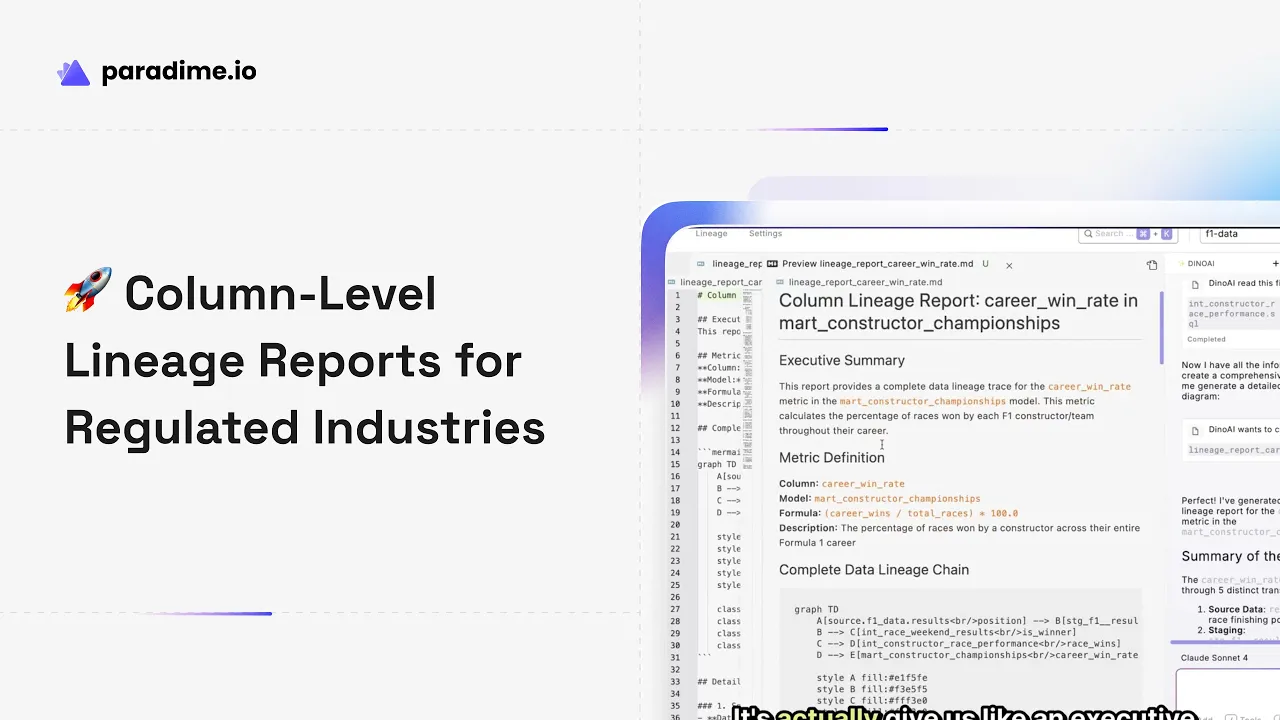
Ask "Where does the customer_email field in my reports come from?" and receive a clear, conversational answer. Follow up with "Is it properly masked at every stage?" to continue the exploration. The system generates mermaid diagrams only when visual representation adds value, making lineage truly actionable rather than passive documentation.
Active Governance vs. Passive Documentation
AI transforms lineage from a documentation tool into an active governance system. Rather than waiting for audits to reveal compliance gaps, organizations proactively identify issues before they become violations.
Automated scanning detects PII without proper masking. Continuous monitoring tracks data flows for regulatory adherence. Real-time alerts trigger when changes impact compliance-critical datasets. AI-generated remediation steps include implementation code, turning identification into action.
On-Demand Documentation That Stays Current
Perhaps the greatest advantage: documentation generated fresh whenever needed, never outdated. Unlike manually maintained documentation that becomes stale within days, automated lineage documentation reflects the current state of pipelines and transformations—with no manual maintenance required.
Audit-ready reports become available instantly, not after weeks of preparation. When regulators request documentation, teams respond with confidence, knowing their lineage reports accurately reflect reality.
Best Practices for Implementing Column-Level Lineage
Start with Automated Discovery
Implement automated lineage capture from day one. Minimize manual lineage mapping to reduce errors and maintenance burden. Ensure your lineage system can trace transformations across all pipeline stages and configure automatic metadata collection from all data sources and targets.
Manual lineage mapping doesn't scale and introduces the same human errors it's meant to prevent. Automated discovery ensures completeness and accuracy from the start.
Build Compliance Reporting into Your Architecture
Design audit trail generation as core functionality, not an afterthought. Configure systems to track data usage, access, and modifications automatically. Establish immutable logs for regulatory requirements and create templates for common compliance reports—GDPR data subject requests, HIPAA breach notifications, and similar regulatory responses.
When compliance reporting is architectural rather than supplementary, it remains reliable under pressure.
Implement Column-Level Granularity
Table-level lineage is insufficient for most compliance scenarios. Track field-level transformations, joins, and calculations. Capture column renaming and aliasing throughout pipelines. Document aggregate calculations and their source columns.
Regulators don't ask about tables—they ask about specific data elements. Your lineage system must provide answers at that granularity.
Ensure Cross-System Visibility
Lineage must span from source systems through transformation layers to BI tools. Track data movement across cloud platforms, databases, ETL tools, and analytics platforms. Integrate with native BI connections like Looker, Tableau, and Power BI. Maintain lineage through orchestration and scheduling systems.
Gaps in lineage create gaps in compliance. End-to-end visibility is non-negotiable.
Enable Root Cause and Impact Analysis
Configure bidirectional lineage supporting both upstream root cause analysis and downstream impact analysis. Implement search and filter capabilities for specific tables, columns, or PII types. Enable scenario analysis: "What happens if we change this field definition?" Provide blast radius analysis before merging code changes.
These capabilities transform lineage from a reporting tool into a decision-support system.
Establish Auditing and Access Controls
Track who accesses lineage information and when. Maintain version history of lineage metadata. Log all manual edits to lineage with full auditing. Implement role-based access for sensitive data lineage.
Your lineage system itself must meet the same compliance standards it helps you achieve elsewhere.
Measuring ROI and Compliance Benefits
Quantifiable Compliance Improvements
The time savings alone justify investment: audit preparation that once required days now takes minutes. Organizations report reducing audit prep from 4 hours to 5 minutes for standard reports. Beyond time, risk reduction provides immeasurable value—proactive PII detection prevents violations before they occur. Faster incident response through immediate root cause identification limits damage from data quality issues. Lower audit costs result from self-service compliance documentation that requires minimal human involvement.
Operational Efficiency Gains
Compliance benefits extend beyond regulatory requirements. Teams report 50-83% productivity improvements in data engineering workflows and 25-50% faster development cycles with confidence in changes. Production incidents decrease as unknown dependencies become visible. Emergency fixes to repair breaking downstream systems become rare exceptions rather than weekly occurrences.
Strategic Advantages
Column-level lineage builds trust with regulators through comprehensive, transparent documentation. It enables data democratization while maintaining governance controls—expanding data access without increasing risk. Organizations can support AI/ML initiatives with provable data quality and lineage, meeting the stringent requirements of emerging AI regulations. Perhaps most importantly, comprehensive compliance capabilities provide competitive advantage in winning customers who require compliance certifications before vendor selection.
Conclusion: From Compliance Burden to Competitive Advantage
Column-level lineage transforms compliance from a manual, reactive process into an automated, proactive governance framework. By leveraging AI-powered lineage tools, organizations in regulated industries can generate audit-ready documentation on demand, track PII automatically, analyze impact before changes, and maintain comprehensive audit trails—all while accelerating development and reducing operational risk.
The question is no longer whether your organization can afford to implement column-level lineage, but whether you can afford not to. With regulatory fines reaching tens of millions of dollars and the complexity of data environments growing exponentially, automated compliance through granular lineage has become essential infrastructure for any organization handling sensitive data.
Start by implementing automated lineage discovery, build compliance reporting into your architecture from day one, and leverage AI to make lineage actionable. Your future auditors—and your data team—will thank you.


