Introducing the new Paradime Website
We have launched the new Paradime website built on Next.js, Vercel, and Sanity.io to ensure that the Paradime website moves as fast as the product. We were on Framer but it lacked a first-class developer experience and that ultimately led us consider a switch, because the website could simply not keep up with the product velocity.

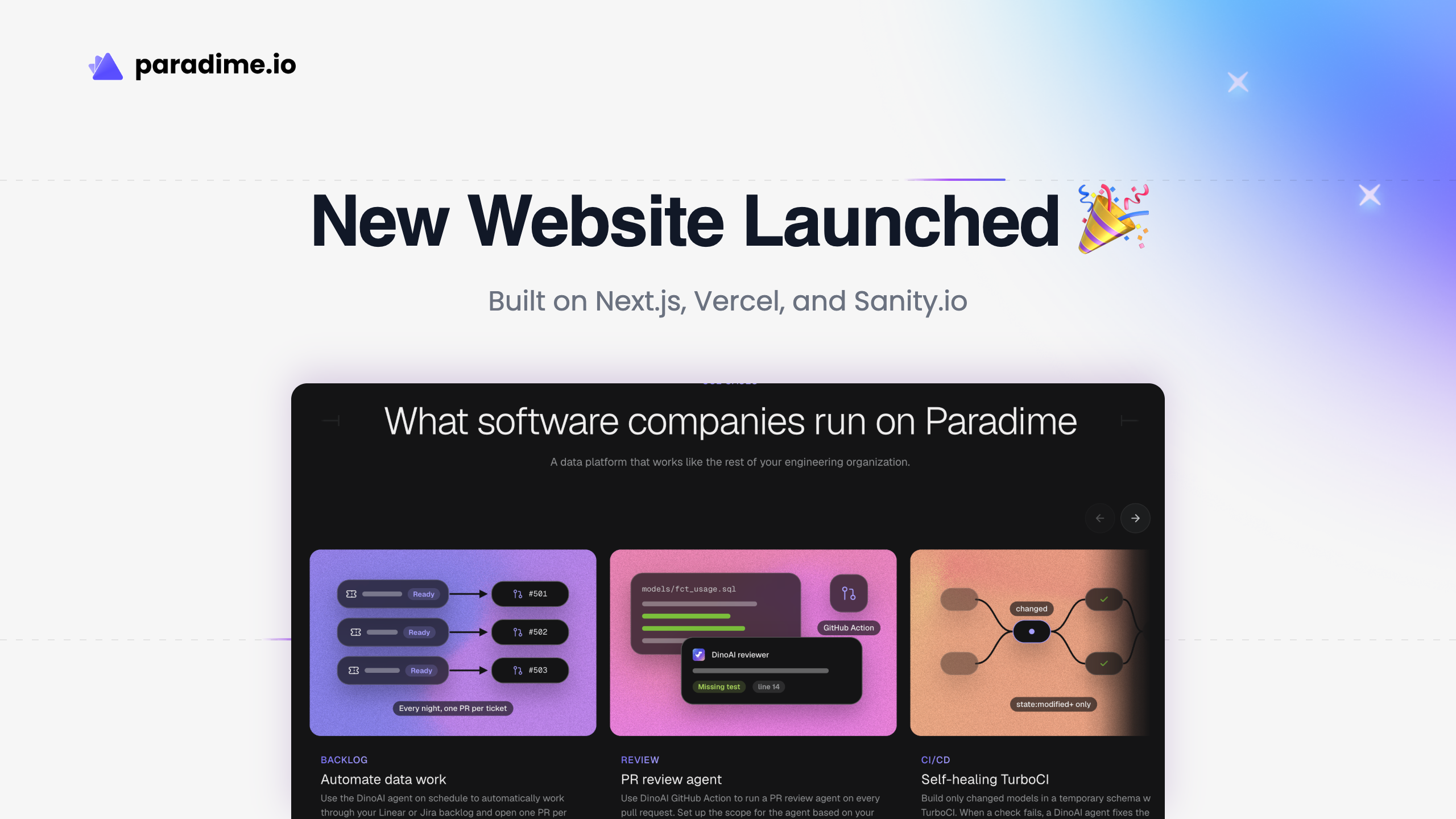
I am thrilled to finally announce the new Paradime Website, which we built completely from scratch using an AI-native tech stack.
Phase 1 - Webflow
At Paradime, we have traditionally been pretty bad with our website. It never felt right. We always felt that it was behind on product and did not really explain what the product does.
We have been on a journey here.
We started off with Webflow back in 2022. It was the only no-code tool out there that could handle most of the complex interactions we were envisioning. Our designers built the design, and we paid a one-person agency $3,000 to turn those Figma designs into Webflow hosted website.
Every time we had a product update we would have to go and make costly time-consuming changes. And there was no way of directly going from Figma into finished Webflow pages.
Phase 2 - Framer
In 2023, we made the decision to move from Webflow to Framer. The tipping point was really funny. More and more of our blog posts needed code fragments and tables, and Webflow editor had almost non-existent support.
So the trigger for the switch was kind of inter-operability.
Framer lasted us really well. We kept building our web pages in Framer and it was really easy to add simple animations, have a component system, design from the component upwards into finished pages and all the goodness around it.
But in 2026, Framer has a problem - it's not developer friendly. It's APIs kind of suck. Their AI copilot is for content operations not design. And they seem to stuck somewhere between focussing on designers who can't code or hardcore Figma users who can't code.
And at the same time our product started to change way faster than the website can keep up. Every illustration was done in Lottie and by the time the designers finish, the product has moved on. So to keep up with that, our website had to change at the same frequency.
Phase 3 - Vercel + Next.js + Sanity.io
So we decided to ditch Framer a few months back. The website was simply not up to date with the product and our vision and every change we needed to make was pain-stacking. While the CMS was working great, the rest of the website design was quite dated.
With the new website, we have done a few things that we could not do before as follows:
- The entire website is built using React, Vite, and Next.js
- It's hosted on Vercel
- We have separated the view layer (React) with the content layer (Sanity)
- We use our DinoAI agents to keep the content fallback updated if Sanity goes down.
What's New?
We have completely re-architected the website navigation, page structure, page content, and density of information.
Header navigation
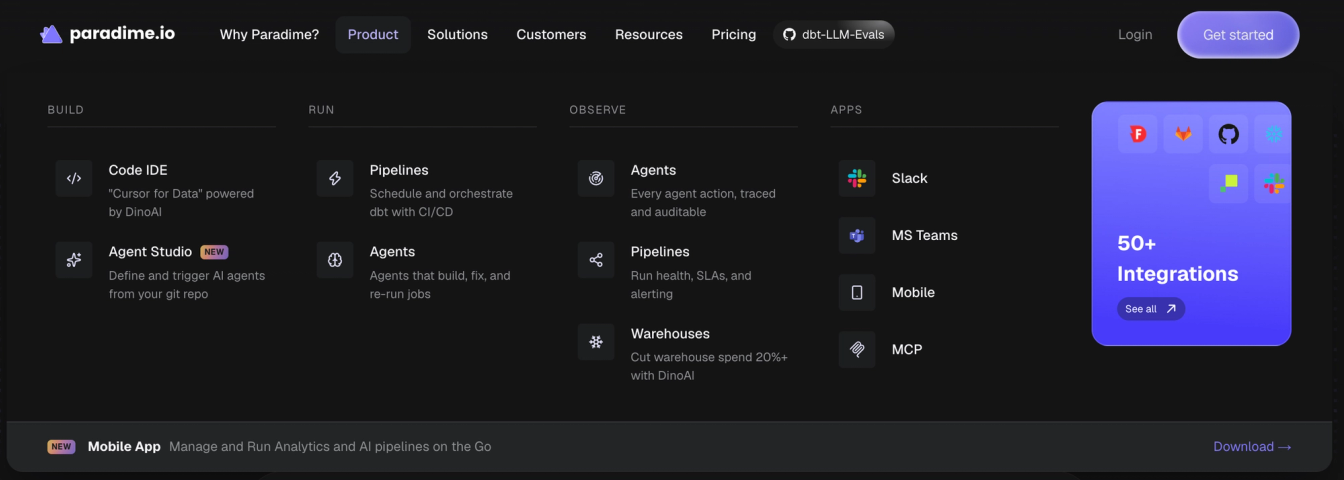
We have replaced rigid product names with what an user can now do on Paradime. The platform now enables users to build, run, and observe data pipelines and Agent workflows. We have also added an apps section, so its easy to find our integrations with Slack, MS Teams, mobile apps, and MCP client/server setups.
Hero Product Experience
Paradime is a complex product and one of the biggest challenges we had in the past is how to distill the complexity of the product while still making sense for a technical audience.
This is like explaining what Databricks does 15 years back. So we needed to strike the right balance. At the same time, we could not rely on hand-crafted animations anymore because animating, generation, file-size optimization - all takes time and needs someone with animation experience.
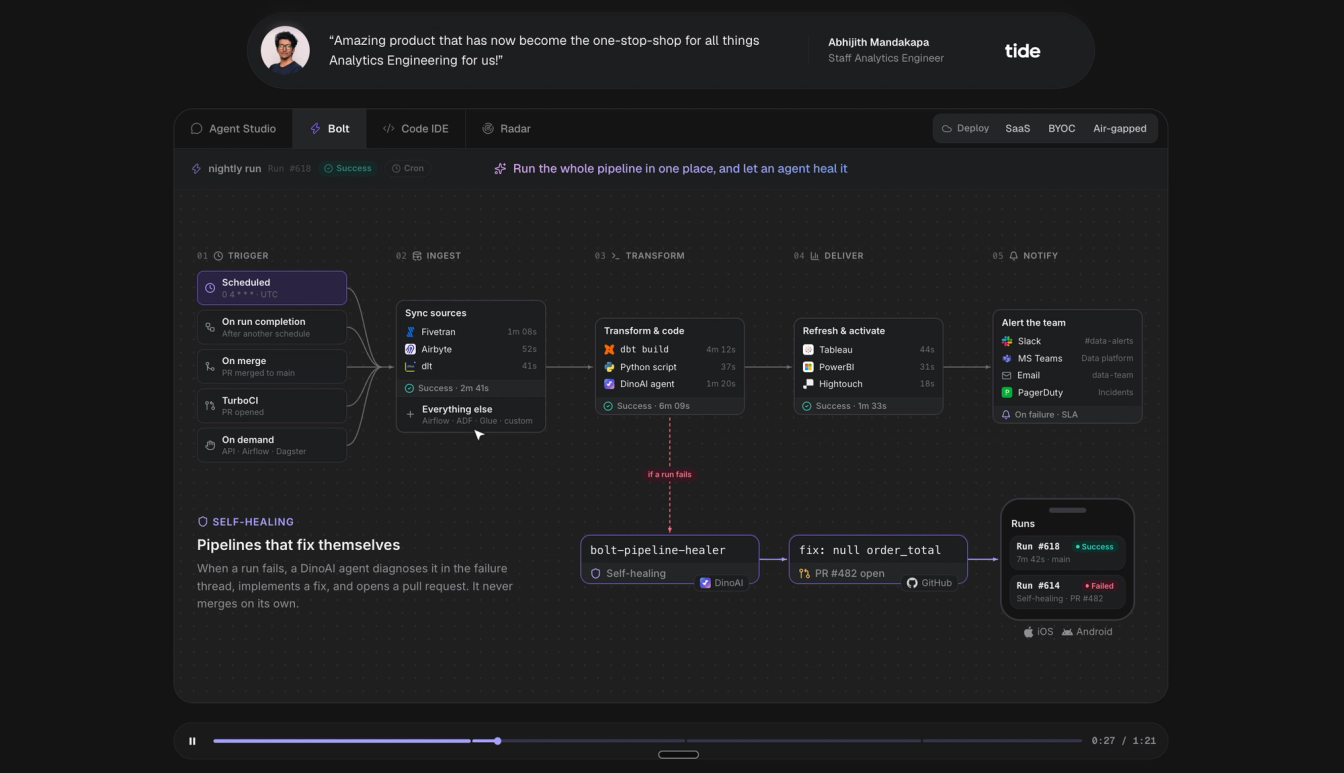
So we scrapped all of that approaches and used React. With Fable 5.1, React, and our own design system in Storybook, we had a pretty robust setup to ground Claude in our design language. After that, we grounded Claude in our frontend code, website code, storybook, and help docs to paint a complete picture of what the product does.
Because this now all code, we can make updates whenever we want to the animation - its a simple code change at that point. Everything is animation, svg, and React, so it's light weight as well to load.
Focus on Solutions and Use cases
A big gap in the previous website was a lack of focus on solutions and use cases. We as a company also did not know what use cases the customers wanted the most. Adding new use case or industry or removing an existing one was a pain.
This is where Sanity.io came in. All the pages had the same structure but the content would be tailored to the team, industry or use-case.
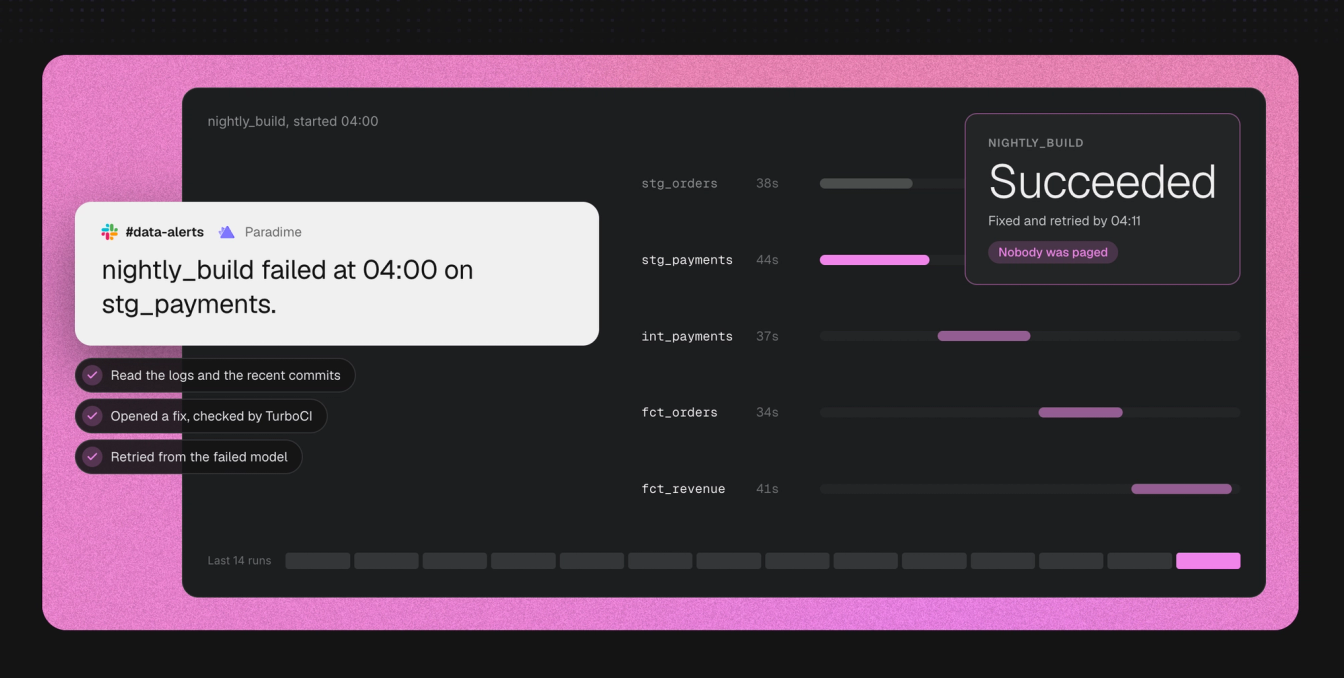
All these images are programmatically generated using a combination of grain-noise shaders. I took 2 brand colors from the design system and asked Claude to keep the same saturation and level (SL of HSL) and then rotate around the color plane at 30 degree intervals to give me 12 more color pairs. and then reduced the saturation by 20% to reduce the glare a bit on a dark background.
The shader shape is determined from a hash of the title and subtitle, so its deterministic but also a function of the card title.
As a result of the algorithmic approach, you get these beautiful colors but they are also slightly different.
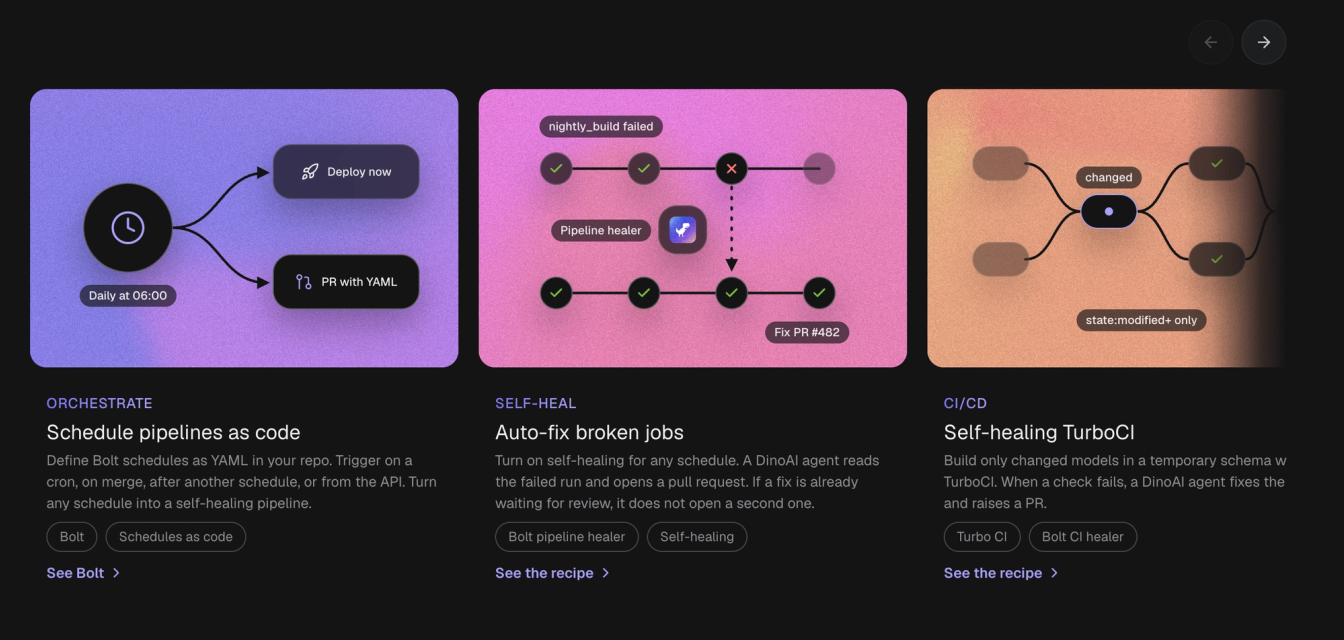
All the images are SVG with shaders built on canvas, so the page is extremely light to load.
Developer Experience
We also wanted to bring the focus back on the developer experience. The agent platform of the future in our opinion would need first-class APIs to drive stickiness. The future application will be used by AI agents, and as a result will need first class APIs. Agents are also much better at discovering features and so users relying on agents to get work done, will find much more value from platform products.
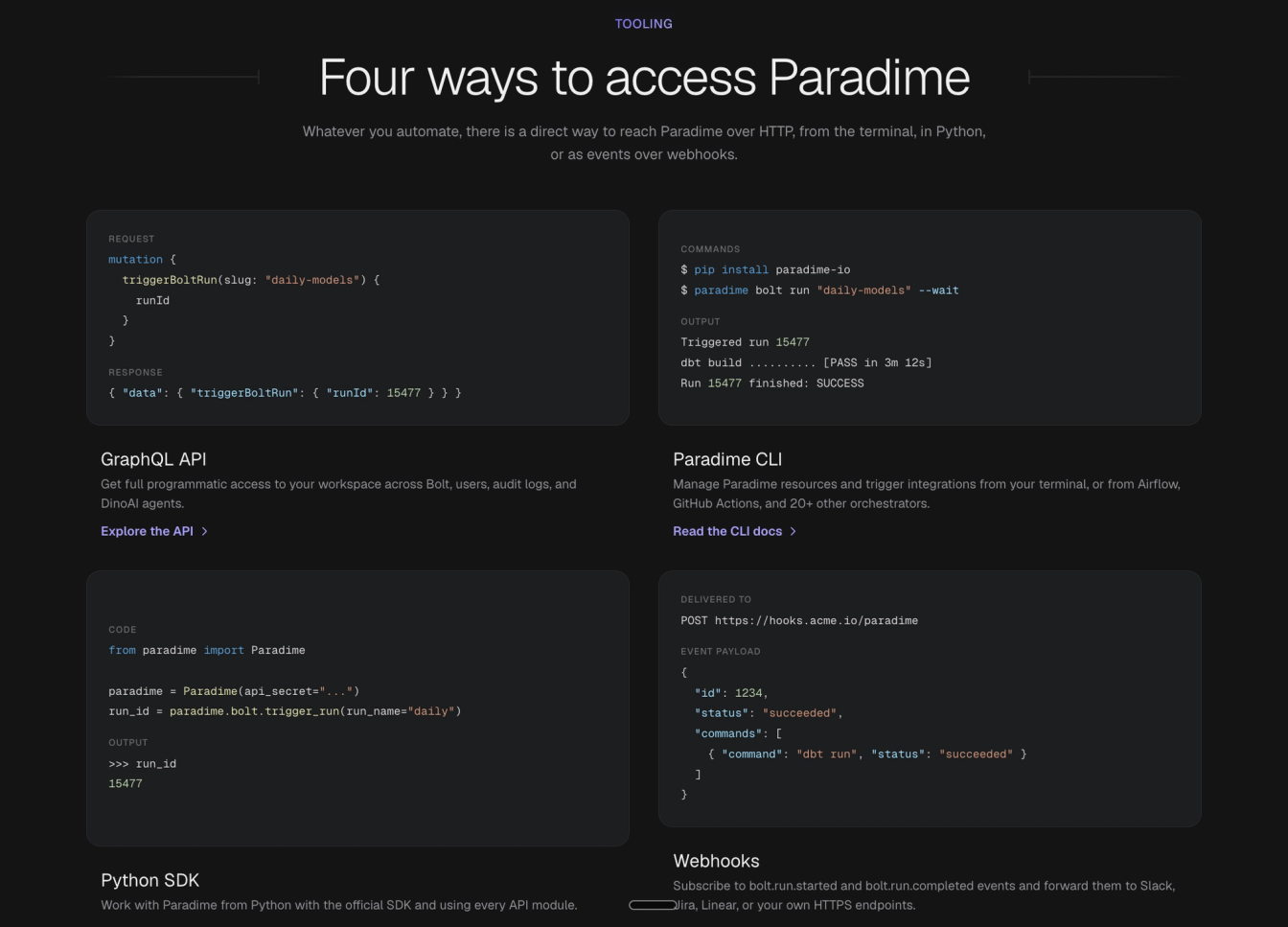
The Paradime product team has been investing in a first class developer experience for a long time, but the challenge was we never had this available on the web page. We have no changed that.
We have now created a dedicated page on Paradime for Developers with all the ways engineering-minded data consumers can use the platform. Another use case is of developers using Paradime to set it up for other users.
Content Operations
In the world of AI, everything moves at the speed of light. So it's only natural that if your engineering team is driving at a million miles an hour, that our website keeps up with it.
So the final missing piece here was content operations. This is where we brought in Sanity.io. Sanity is a knowledge base for content. But we found its a lot more than that. With first class APIs and agentic interactions available, we have now created document models for every kind of website page. Even this blog is now written inside Sanity. But the real power of it will be when we connect product releases with content updates. Our goal is the day we release a new feature or product update, we are able to release a website product update or use case update too.
Role of the designer
A big shift that is also we are doing is changing the role of the designer. Designers at Paradime used to just do design, and then use low-code tools like Webflow and Framer to translate those into finished and polished designs. For technical products like Paradime, this created 2 bottlenecks as follows:
- The designer had to translate a technical product into technical illustration, which would take hours
- If they did the above, all other marketing design work would stop
- A third issue would be sometimes it would take a long time for a GTM-led design change to make it live and the opportunity would be gone i.e. field operations is way ahead of the website.
With the new stack, we have now changed that role completely. The design team at Paradime now spends time designing the facts that LLM models like Claude etc. can work upon. So the design team builds the design system, builds complex interactions that requires WebGL or three.js, and lastly, run the marketing design roadmap.
They can also design and build website but that's not a blocker anymore for anyone in the organization. Anyone from the founder onwards can update the website and it would look consistent. There is CI built in so nothing weird can go online without approval.
But we have completely eliminated the handover process.
Conclusion
Finally, our goal is to move faster than our competitors because demand from our users is going up exponentially and we should be there to meet that demand. Our competitors are either no efficient or have too many people with coordination tax to pay all around.
I think we have made the right call here on the infra and tooling. The website is now at par with the product and we will be able to move as fast as the engineering and product team.
Check out the new website at https://www.paradime.io - if you are reading this, you are already on the new website.
Interested to Learn More? Try Out the Free 14-Days Trial
One AI-native workspace to build, ship, and monitor dbt™ — without the tool sprawl.
More Articles
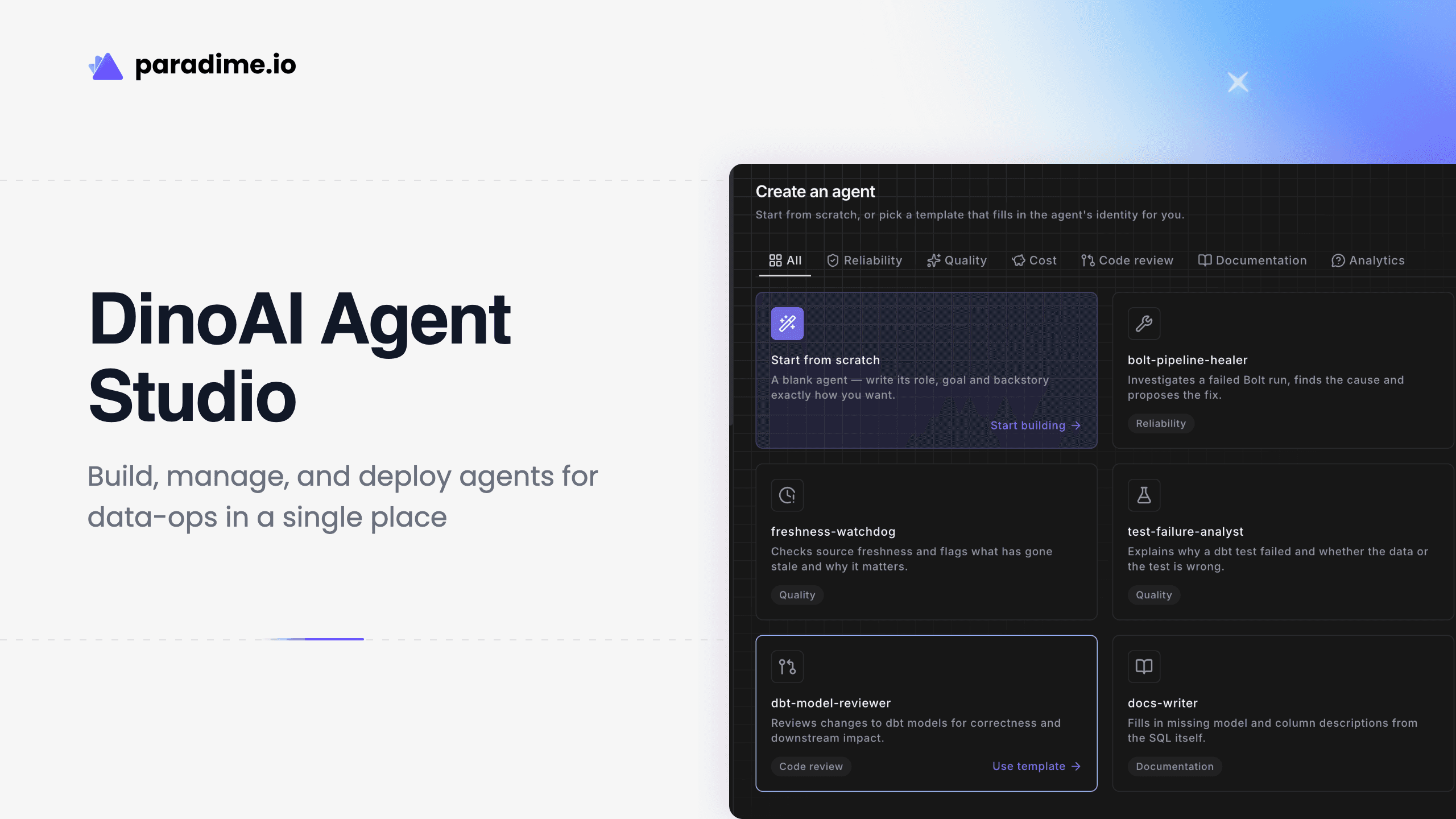
Join industry leaders winning with DinoAI agents
Data engineers and analysts at the most AI-native startups and enterprises use Paradime's DinoAI agents everyday to become market leaders.